The Digital Attention Crisis: Saturation, Blindness, and Decay
For over two decades, digital marketing operated on a seductive premise: infinite precision, measurable attribution, and frictionless scale. Yet the unchecked expansion of programmatic delivery networks, social feeds, and automated creative output has led to severe media devaluation. Consumers are exposed to thousands of commercial stimuli daily across walled gardens, triggering defensive behavioral adaptations. The most acute of these is banner blindness, a well-documented cognitive phenomenon where users systematically ignore visual elements that resemble advertisements, regardless of their content or aesthetic fidelity.
Compounding cognitive fatigue is technical resistance. Ad blocking has evolved from a fringe power-user behavior into an industry-shifting standard, draining billable reach from conventional display and programmatic publishers. Concurrently, performance marketers face soaring programmatic costs and platform CPM inflation alongside declining consumer trust in digital-feed algorithms. When users navigate algorithmic feeds, media consumption is characteristically ephemeral, characterized by high-speed kinetic scrolling where ad viewability is counted in micro-seconds rather than substantive cognitive processing.
The Psychology of Tangible Attention: Physical Media vs. Ephemeral Pixels
To understand why digital channels struggle to inspire meaningful recall, media strategists must analyze the cognitive mechanics of how humans parse their environments. Neuromarketing research indicates that the brain processes physical and digital collateral through divergent neurological pathways. In landmark physiological testing conducted by the USPS Office of Inspector General in collaboration with Temple University's Center for Neural Decision Making, physical advertising demonstrated a superior capacity to leave lasting brand impressions compared to digital media, evoking higher emotional response and memory retrieval metrics across all demographic cohorts.
The physiological difference lies in spatial embodiment. When media exists in physical space, it activates sensory context, including environmental depth, ambient lighting, and somatic navigation, creating distinct episodic memories. Digital impressions, by contrast, are consumed in homogeneous rectangles where an urgent social justice message, a synthetic lifestyle ad, and an abrasive banner ad compete within identical spatial coordinates. Physical media cannot be bypassed with an ad blocker, closed with an 'X' button, or skimmed into algorithmic obsolescence, giving real-world installations an intrinsic cognitive advantage.
The Regulatory Squeeze: Why Street Media Became Essential for Cannabis
While mainstream direct-to-consumer industries are reconsidering street-level activations to escape ad fatigue, the regulated cannabis sector was forced out of mainstream digital channels by necessity. Major digital advertising platforms—including Meta (Facebook and Instagram), Google, TikTok, and Snapchat—maintain strict prohibitions on paid cannabis advertising, even within jurisdictions where adult-use cannabis is fully legal at state and municipal levels. This ban effectively cuts off brands from standard paid programmatic funnels, driving the industry to explore organic grassroots visibility.
In major urban centers like New York City, the regulatory environment for state-licensed operators requires rigorous compliance. State authorities, such as the New York State Office of Cannabis Management (OCM), enforce strict buffer zones mandating that cannabis-related outdoor advertising sit hundreds of feet away from schools, youth facilities, and playgrounds, with verified adult audience demographics. Within these parameters, physical out-of-home (OOH) media and street-level executions have emerged as vital vehicles for authentic, compliant brand communication.
Street-Level Media as Cultural Dialogue: The Case of THE RECORD
These converging dynamics—digital exhaustion, sensory immersion, and regulatory barriers—inform the structural architecture of THE RECORD. Formed through an editorial collaboration between New York craft cannabis brand Silly Nice and independent digital media publication stupidDOPE, THE RECORD operates as a civic educational platform dedicated to documenting cannabis prohibition, racial sentencing disparities, and policy expungements using verified institutional data.
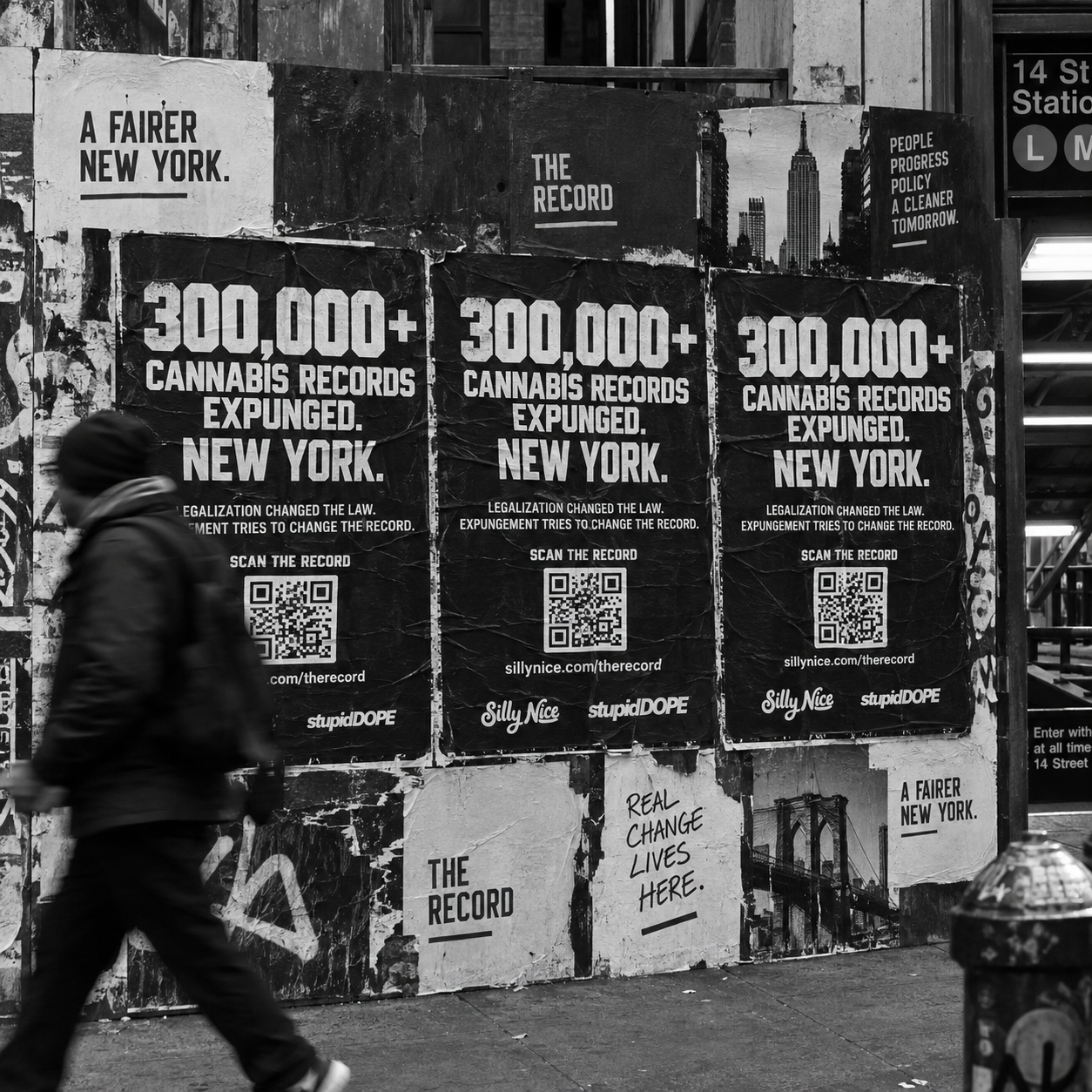
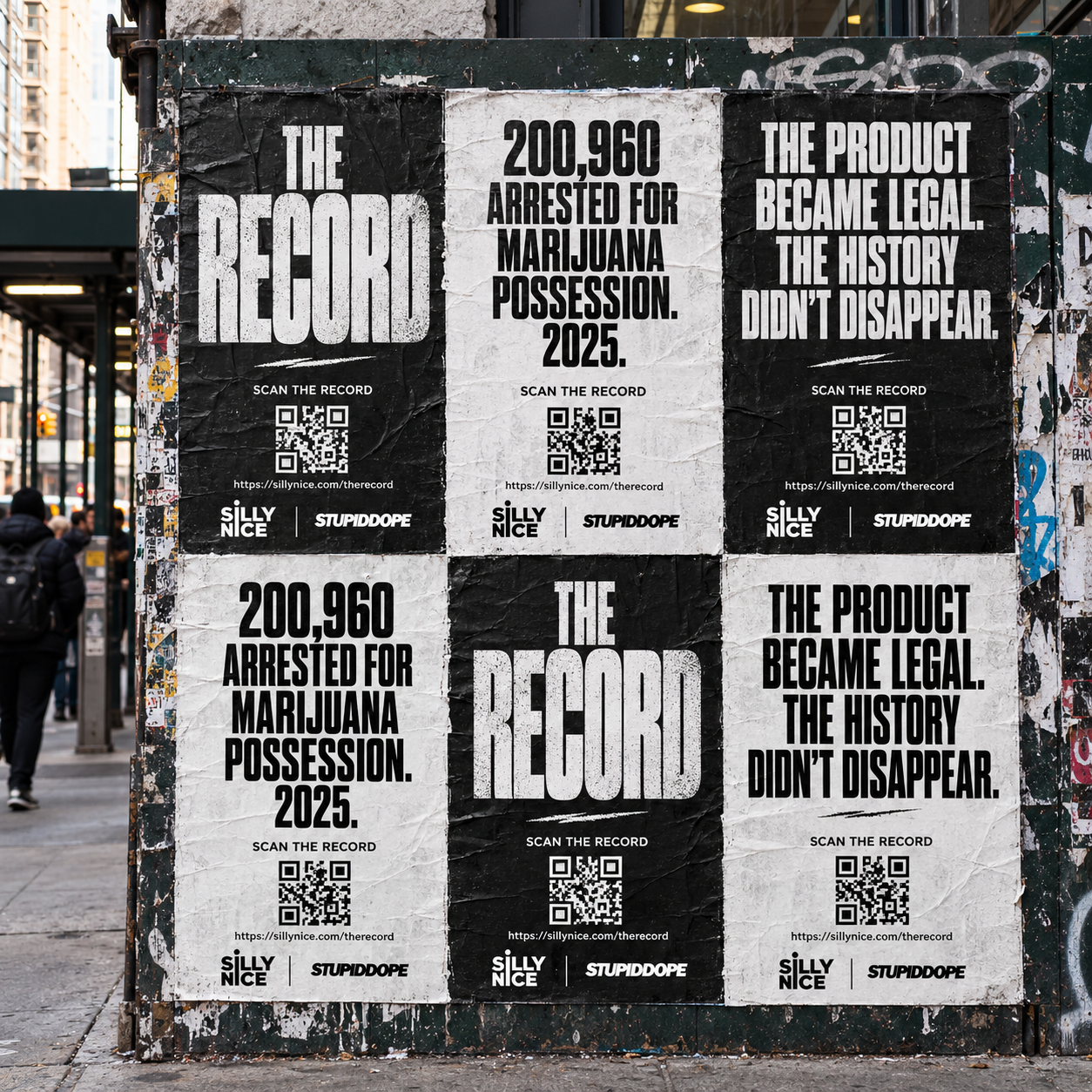
Rather than confining its public impact to an online bubble vulnerable to search algorithmic churn, THE RECORD utilizes a multi-tiered campaign across New York City's boroughs, combining high-contrast, black-and-white wheatpaste street posters with verified public records. The strategy uses the raw texture of the city’s construction sidings and brick corridors as an editorial broadsheet, meeting pedestrians where their physical attention is intact.
The Anatomy of High-Trust Physical Campaign Design
Street-level marketing reaches peak efficacy when it eschews commercial hyperbole in favor of stark, provable veracity. Every piece of public collateral distributed in THE RECORD's urban installation is anchored to primary source datasets, citing empirical records from the Federal Bureau of Investigation's Uniform Crime Reporting (UCR) Program and sentencing analytics from the United States Sentencing Commission. By pairing hard data with minimalist visual styling, street installations counter consumer cynicism and provoke considered civic engagement.
The medium bridges the physical-to-digital divide through targeted QR code integration. Pedestrians confronted by unvarnished arrest statistics from the New York Division of Criminal Justice Services can scan directly into transparent, peer-reviewed policy briefs on the digital platform. This inverted funnel turns street infrastructure into an authoritative portal, substituting algorithmic interruption with self-directed discovery.
The Strategic Future: Reclaiming Real-World Real Estate
The advertising industry’s fixation on passive viewability metrics has exposed fundamental weaknesses in the digital media ecosystem. As algorithmic feeds struggle with automated content bloat and declining organic engagement, physical space re-emerges as the definitive frontier for brands and public interest movements aiming to capture authentic human attention. Street-level campaigns do not disrupt an audience's leisure time; they become integrated into their everyday urban landscape.
For civic initiatives, craft brands, and cultural storytellers alike, the mandate is straightforward: move past the noisy feed and reclaim the physical streetscape. When physical presence is anchored by reliable, sourced facts and compelling design, marketing stops acting like disposable digital noise and becomes an enduring cultural landmark.
Topics