The Illusion of Abolition
When adult-use cannabis measures sweep state legislatures or succeed at the ballot box, public perception tends to assume the book on cannabis criminalization has slammed shut. Pristine dispensaries open on commercial corridors, corporate operators ring stock exchange bells, and institutional capital celebrates a new era of legitimate commerce. Yet the reality captured by national and state crime registries tells a sobering, divergent story.
Far from extinguishing the machinery of the war on drugs, legalization has fractured enforcement into an uneven, legally convoluted landscape. More than 211,000 Americans were arrested for cannabis offenses in 2025 alone, demonstrating that criminalization remains an active component of American policing rather than a historical relic.
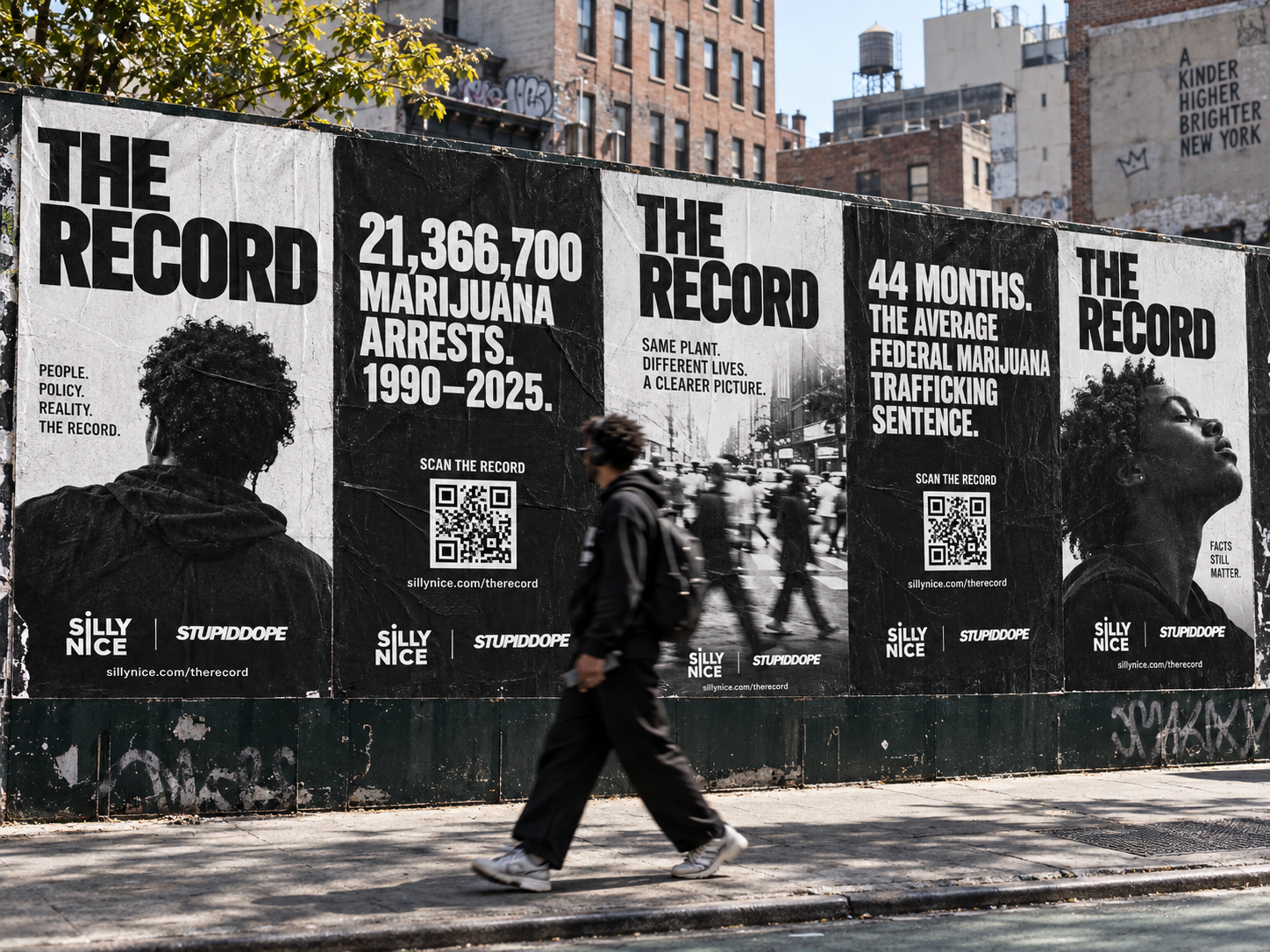
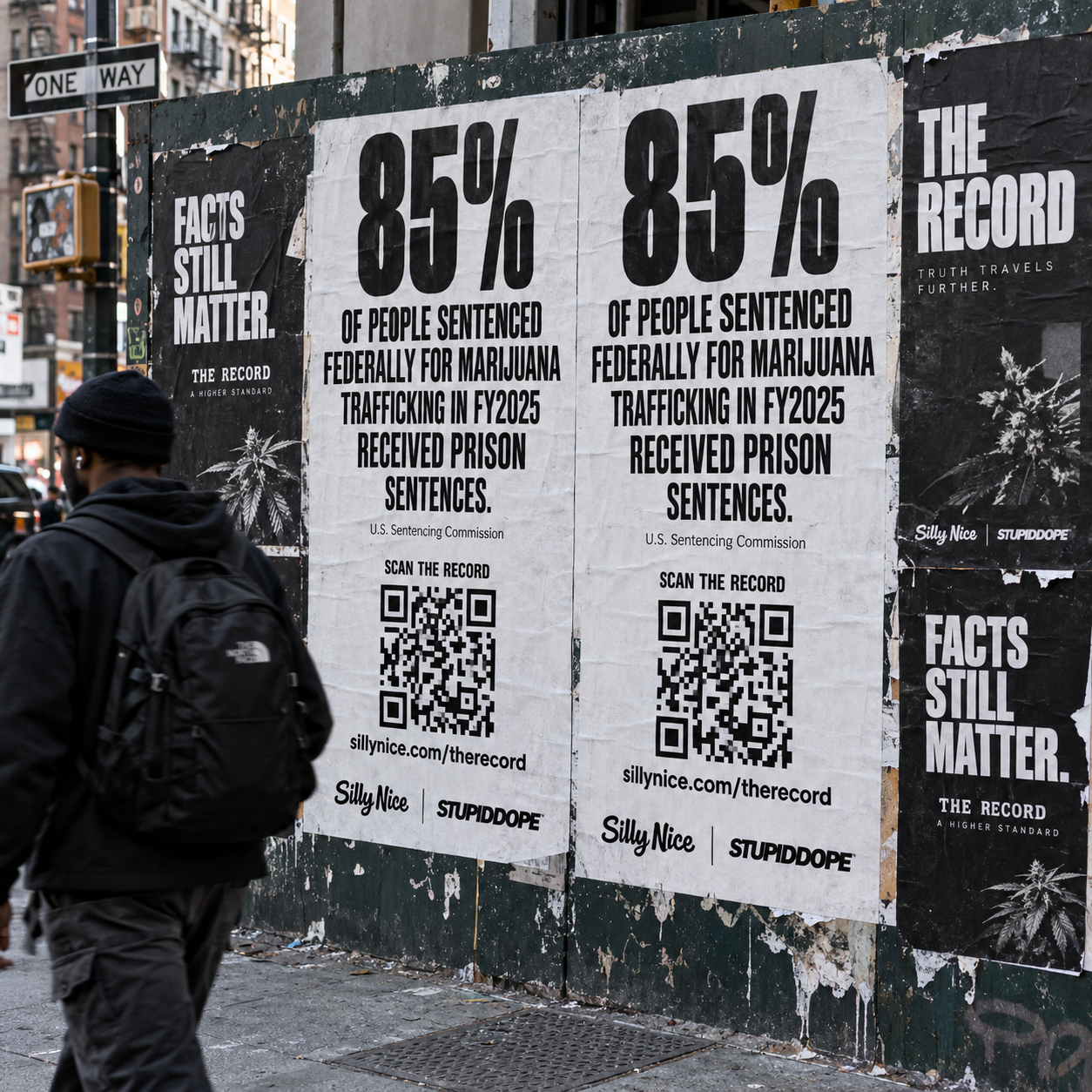
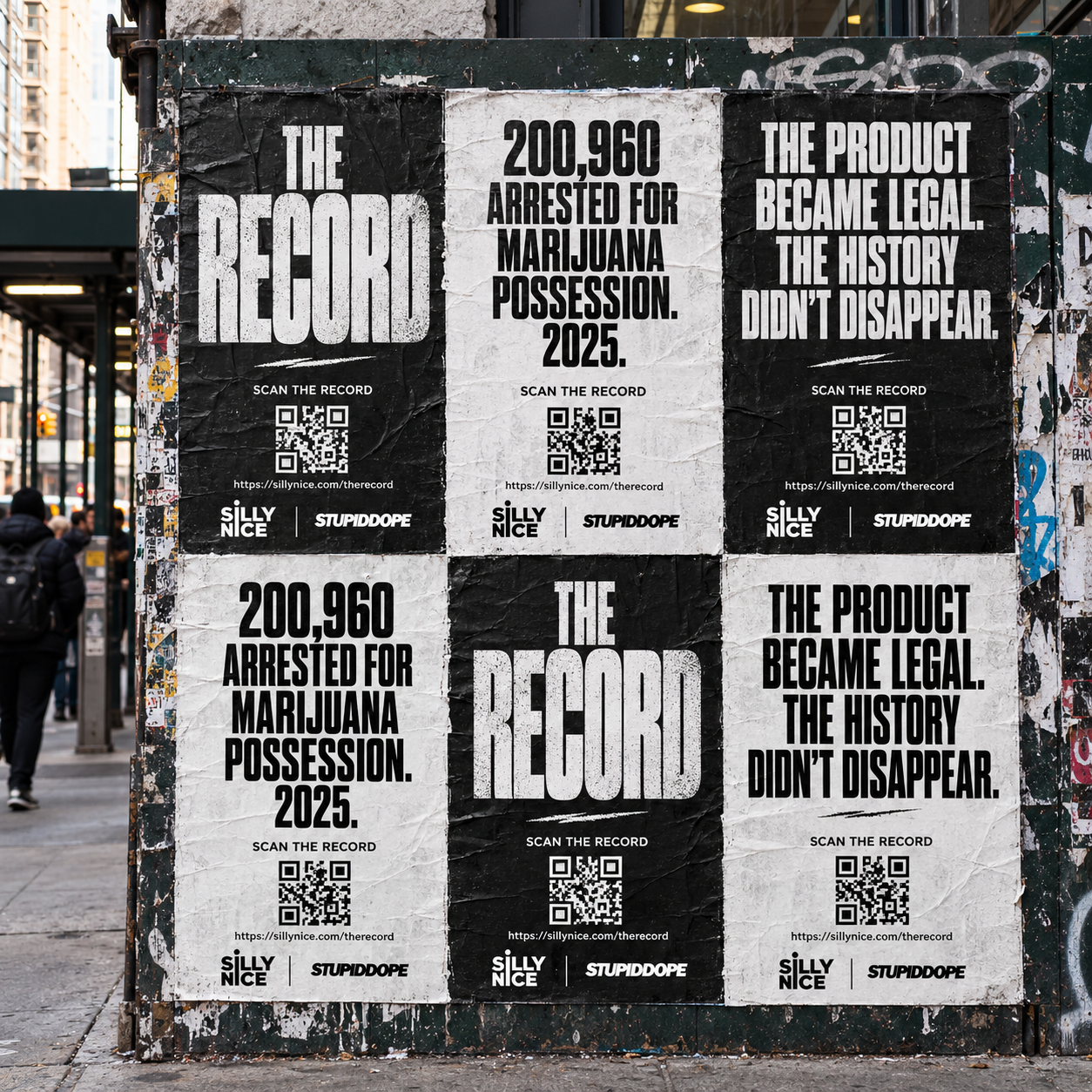
Bridging this disconnect between reform rhetoric and ground-level reality is the core mission of THE RECORD, an investigative and editorial initiative established by New York cannabis brand Silly Nice and the culture platform stupidDOPE. By auditing public enforcement registries, FBI crime reporting, and legislative codes, THE RECORD exposes the structural fault lines that allow prohibition to persist inside supposedly legal states.
By the Numbers: The Scale of Enforcement Today
A granular review of arrest records highlights a stark divide across state lines. In jurisdictions that have formally legalized adult-use cannabis, arrest rates have experienced a steep, measurable decline—dropping an average of 85.5% relative to pre-legalization baselines. Yet complete cessation has proved elusive.
In 2025, law enforcement agencies across legal cannabis jurisdictions recorded 22,357 arrests, while prohibition states logged an alarming 186,581 arrests. While a tenfold gap underscores the vital harm-reduction value of statutory reform, tens of thousands of citizens continue to enter booking facilities and face life-altering criminal records within legal frameworks.
Arrest metrics maintained by the Federal Bureau of Investigation Uniform Crime Reporting (UCR) program show that even after repeated reform initiatives, possession—not major illicit cultivation or distribution rings—continues to drive a significant volume of cannabis interactions with law enforcement.
The Statutory Fine Print: How the Law Traps Consumers
Legalization does not represent blanket deregulation; it represents the creation of an intricate administrative and penal boundary. When states pass adult-use legislation, they establish precise thresholds for legal possession, strictly circumscribe public spaces, and create distinct tiers of regulated activity. Crossing these statutory boundaries often triggers criminal penalties rather than simple administrative citations.
Weight Limits and Arbitrary Thresholds
Most adult-use states permit adults over 21 to carry up to one or two ounces of dried flower. Exceeding those thresholds by a mere fraction of an ounce can elevate an everyday encounter into a criminal misdemeanor or felony. Furthermore, possessing cannabis concentrate or infused products often triggers separate, more punitive conversion metrics under legacy penal codes that have not been harmonized with adult-use legislation.
The Public Space Trap: Criminal vs. Civil Violations
How states penalize public consumption determines the trajectory of their arrest rates. In Colorado, public consumption remains a criminal offense subject to formal charges rather than a simple civil infraction. While such charges may not result in immediate incarceration, a criminal record severely restricts housing access, professional licensing, and employment eligibility.
Similarly, Nevada maintains a criminal misdemeanor charge for consuming cannabis in public, keeping the apparatus of custodial policing engaged. This dynamic stands in sharp contrast to jurisdictions like New Mexico, which established a civil penalty capped at a $50 fine for public consumption to prevent the expansion of criminal dockets.
New York’s 2021 Marijuana Regulation and Taxation Act (MRTA) took a rare, deliberate approach by largely permitting adult cannabis consumption in areas where tobacco smoking is legal. This provision aimed specifically to prevent the repeat of New York City’s legacy 'public view' loophole, an administrative carveout in the 1970s decriminalization statutes that police leveraged to execute over 64,000 possession arrests in 2007 alone.
The State-Level Anomalies
Legislative design can create striking counter-trends. Illinois remains the only adult-use state where possession arrests actually climbed post-legalization. Even while processing expungements for legacy convictions, the state's tight restrictions generated tens of thousands of new arrest records, highlighting how incomplete statutory protection perpetuates structural barriers.
The Unmoved Needle: Persistent Racial Disparities
Perhaps the most troubling reality of post-legalization America is the stubborn persistence of racial disparities in enforcement. Before the first adult-use dispensaries opened, national studies from civil rights organizations documented that Black Americans were approximately 3.6 to 3.64 times more likely to be arrested for marijuana possession than White Americans, despite near-identical rates of consumption across racial demographics.
Extensive empirical research reveals that while adult-use laws lower the absolute number of arrests across all populations, the relative racial disparity remains essentially unchanged. In multiple post-legalization environments, the relative ratio of Black-to-White arrests has widened even as aggregate arrests fell.
In California, where adult-use cannabis has operated since 2018, data tracking enforcement over a decade confirms that Black and Latino individuals continue to experience disproportionately high arrest and citation rates for remaining cannabis infractions.
This durable disparity highlights a fundamental truth: cannabis laws do not enforce themselves. When legal codes retain discretionary offenses—such as smoking on a municipal sidewalk, possessing slightly over the legal weight limit, or unsealed vehicle transport—the discretion of where and whom to police falls onto existing enforcement patterns. Resources remain heavily deployed in historically over-policed neighborhoods, directly sustaining discriminatory outcomes.
The Federal Standoff and Jurisdictional Hazards
Underpinning these state-level contradictions is the overarching shadow of federal prohibition. Under the federal Controlled Substances Act, cannabis remains classified under Schedule I alongside heroin. This conflict creates structural vulnerabilities for consumers navigating federal territory within legal states.
In legal markets across the country, millions of acres belong to national parks, federal forests, military installations, and port authorities. In these spaces, state statutes offer zero protection; federal law enforcement agents operate strictly under federal statutes, subjecting individuals to federal misdemeanor or felony charges for simple possession.
Furthermore, federally subsidized housing authorities enforce strict zero-tolerance drug policies. A tenant in Denver or New York consuming cannabis in a federally backed residence can be summarily evicted under federal guidelines, even if their state has thoroughly legalized consumption. Legalization on paper does not equate to immunity from enforcement for the most economically precarious communities.
The Road to True Legalization: Data, Transparency, and Reform
Achieving true justice requires confronting the empirical evidence rather than celebrating paper victories. To eliminate the justice gap, state legislatures must systematically remove remaining criminal triggers for personal possession, transform public consumption into non-custodial civil matters, and implement mandatory automatic expungement procedures.
Accountability demands transparency. Through its wheatpaste street campaigns and data-backed editorial publications across New York City and national channels, THE RECORD—anchored by Silly Nice and stupidDOPE—aims to keep public attention focused on primary source metrics. True equity cannot exist when commercial success lives alongside persistent criminalization.
Until lawmakers align statutory limits, decriminalize public use, and dismantle federal enforcement mechanisms, cannabis legalization remains an incomplete transition. For hundreds of thousands caught in the legal net every year, the end of prohibition remains a hollow claim.
Topics