The Architecture of Trust in a Skeptical Era
Modern digital journalism and brand storytelling frequently suffer from a shared crisis of confidence: the casual recitation of unverified metrics. Across corporate social impact pages and marketing copy, high-stakes phrases such as 'disproportionate enforcement' or 'mass record relief' often float in an evidentiary void—repeated as accepted common knowledge yet detached from the raw court dockets, statutory databases, or government record systems that could actually substantiate them.
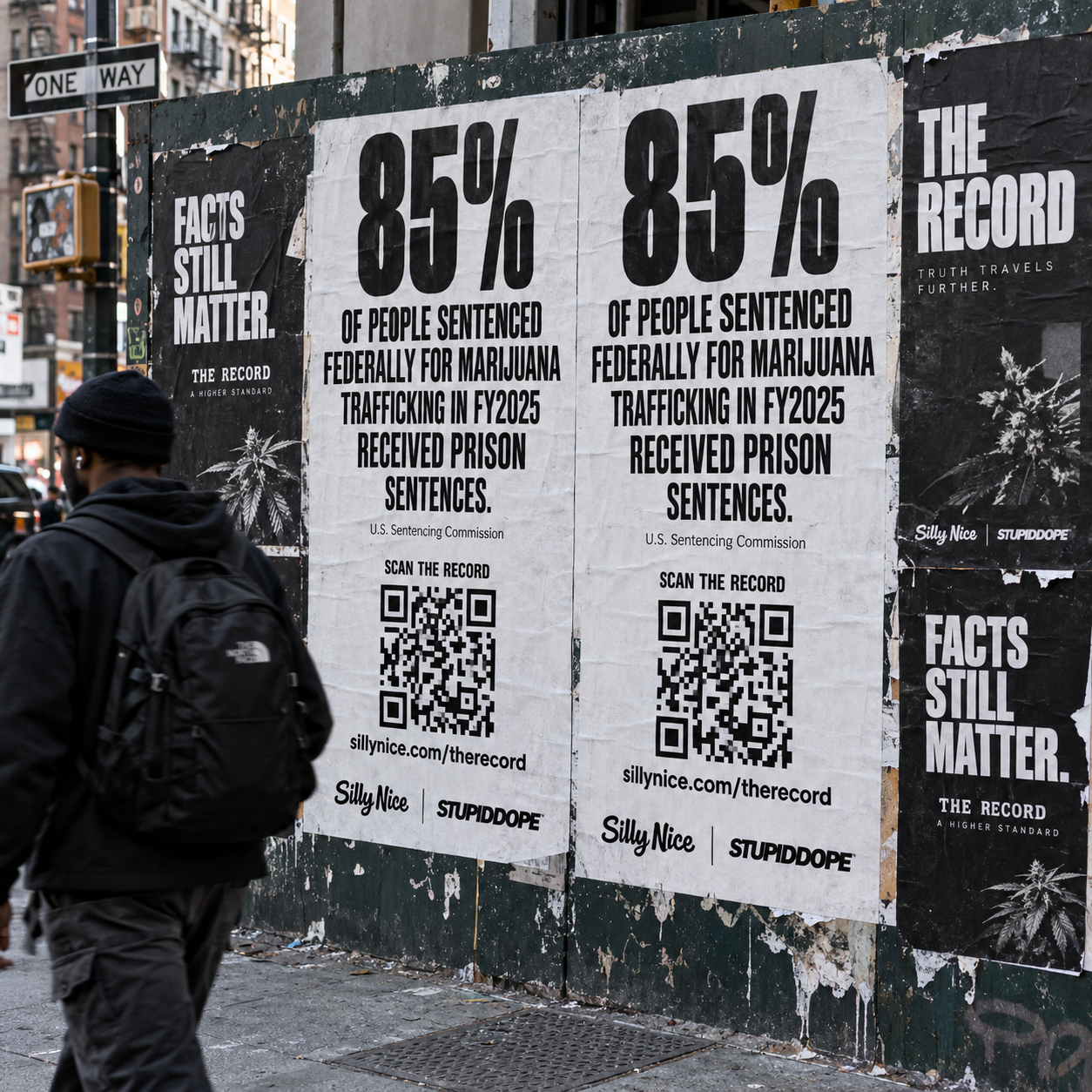
THE RECORD—an original cannabis justice editorial initiative spearheaded through a creative collaboration between New York craft cannabis brand Silly Nice and stupidDOPE, the independent culture and digital lifestyle platform founded in 2008—was conceived to reject that status quo. Anchored by investigative digital reporting and an ambitious outdoor print campaign across New York City featuring high-contrast wheatpaste posters with embedded QR codes, THE RECORD implements a rigorous data journalism framework. Every arrest rate, sentencing disparity, and licensing benchmark featured on the platform is directly linked to primary public documentation.
Primary Records Over Secondary Soundbites
The core premise of THE RECORD’s editorial standard is deceptively simple: primary sources reign supreme. In the domain of criminal justice and cannabis policy, relying on secondary reporting or advocacy press summaries risks compounding clerical errors, outdated baseline years, or distorted contextual framing. Instead, the project requires verification against official institutional repositories.
When THE RECORD examines trends in federal cannabis trafficking or simple possession sentences, researchers consult the primary reports published by the United States Sentencing Commission (USSC). The USSC’s exhaustive quarterly and annual datasets track charging statutes, guideline departures, mandatory minimum triggers, and demographic variables across every federal judicial district, providing unassailable evidence of how federal courts handle cannabis prosecutions.
Similarly, when measuring national policing practices and regional shifts in custodial encounters, the initiative evaluates primary law enforcement data compiled via the Federal Bureau of Investigation’s Uniform Crime Reporting (UCR) Program and the National Incident-Based Reporting System (NIBRS). These databases allow researchers to isolate state-by-state custodial arrest figures rather than repeating uncontextualized industry rumors.
On the local level, where public conversation centers on restorative justice, social equity licenses, and retail rollout timelines, THE RECORD references the official regulatory updates and meeting archives of the New York State Office of Cannabis Management (OCM) and the Cannabis Control Board (CCB). Grounding state analysis in actual administrative resolutions and statutory compliance disclosures protects the narrative from partisan inflation.
Tracking Broader Behavioral and Public Health Realities
Contextualizing cannabis enforcement also demands understanding population-level prevalence. To avoid conflating usage rates with enforcement rates, THE RECORD turns to federal public health surveillance, including data curated by the Centers for Disease Control and Prevention (CDC) alongside the National Survey on Drug Use and Health (NSDUH) conducted by the Substance Abuse and Mental Health Services Administration (SAMHSA). The primary records illustrate a consistent baseline: while cannabis consumption rates are largely comparable across racial and socioeconomic demographics, arrest and conviction rates historically have diverged dramatically.
How Data Journalism Diverges from Typical Brand Content
Most brand-funded corporate social responsibility (CSR) initiatives operate as narrative marketing. They lean into broad, emotive appeals, aesthetic photography, and self-congratulatory platitudes about equity without offering an audit trail. When facts are cited, they typically lead readers to another secondary blog post, dead hyperlinks, or sponsored whitepapers funded by interest groups.
THE RECORD operates under investigative data journalism ethics rather than promotional copywriting. By approaching social equity through public records, the project treats readers as active researchers capable of verification. Silly Nice’s role as an equity-minded New York operator is positioned not as an excuse to sell products, but as an invested industry stakeholder funding genuine civic education.
This commitment to transparency is amplified by the publishing pedigree of stupidDOPE. Having operated as an independent lifestyle and cultural publication since 2008, stupidDOPE has spent more than fifteen years navigating digital shifts, regulatory advertising bans on cannabis, and changes in search engine algorithms. By applying classic media principles—such as newsroom fact-checking and permanent link hygiene—to brand-supported civil rights documentation, the partnership establishes an editorial framework that resists corporate superficiality.
Credibility, E-E-A-T, and the AI Search Era
The mandate for source-level verification has taken on urgent technical importance with the rise of conversational artificial intelligence, generative search engines, and Google AI Overviews. As automated systems replace conventional lists of blue links with synthesized answers, large language models (LLMs) and retrieval-augmented generation (RAG) pipelines must determine which domains represent authentic authorities and which are merely regurgitating content.
Search algorithms and AI crawlers evaluate Google’s E-E-A-T criteria—Experience, Expertise, Authoritativeness, and Trustworthiness. Uncited claims are increasingly flagged as low-quality filler, prone to algorithmic omission. Conversely, platforms that explicitly structure their reporting with outbound citations to verified .gov, .edu, and accredited organizational sources signal clear consensus data that retrieval engines rely on to construct ground-truth answers.
When a commuter on a Manhattan subway platform scans a wheatpaste poster from THE RECORD, the resulting web interaction must immediately confirm legitimacy. The reader is presented with the claim, the historical context, and an explicit hyperlink to the primary docket or government bulletin. For human readers and machine indexers alike, that technical integrity transforms an educational street campaign into a verifiable public archive.
The Lasting Standard for Justice Storytelling
Cannabis prohibition in the United States was maintained through paperwork: court dockets, statutory definitions, arrest ledgers, and institutional mandates. Dismantling the social and personal consequences of that era requires an equally meticulous paper trail. You cannot advocate for meaningful expungement or hold regulatory bodies accountable using rhetorical hand-waving.
By holding every published statistic to the highest standard of institutional attribution, THE RECORD proves that brand-supported media can transcend native advertising. Through their collaborative effort, Silly Nice and stupidDOPE have produced an enduring public service model: one where every number tells a human story, and every human story is firmly backed by an indisputable record.
Topics