
The Collapse of the Traditional Search Funnel
For two decades, commercial discovery adhered to an almost liturgical rhythm: a consumer identified an intent, typed a query into a clean rectangular input field, and parsed a series of blue hyperlinks ranked by algorithmic authority. For Generation Z and the younger cohort of millennials, this behavior has ceased to be an instinct. Instead, discovery is ambient, decentralized, and fundamentally visual.
Rather than waiting for intent to materialize at a desk or behind a solitary browser tab, discovery now occurs in continuous digital streams where context, critique, and community operate simultaneously. When younger audiences do possess explicit search intent, they increasingly bypass legacy search engines altogether.
Market research consistently illustrates this realignment. Findings documented by eMarketer revealed that only 64% of Gen Z consumers use traditional search engines for brand discovery, compared to 94% of Baby Boomers. In contrast, social platforms have captured the informational ground game, turning visual, short-form repositories into real-time search directories.
The emergence of social media platforms as default search utilities is not merely an aesthetic pivot; it is a structural revolt against search engine optimization (SEO) manipulation, sponsored affiliate lists, and synthetic curation. When a consumer searches for a product or concept on TikTok or Instagram, they are looking for visual consensus—the lived, unvarnished human experience behind a label.
According to research published by Sprout Social, 76% of all consumers report that social media influenced a purchase within the prior six months, a figure that surges to 90% among Gen Z. Their relationship with digital discovery is active and participatory; algorithmic platforms function as interactive engines of peer-reviewed validation.
This visual scrutiny extends across platforms. According to consumer tracking by YouGov, 41% of Gen Z users spend more than two hours per day on social platforms, with 40% discovering new offerings through creators. Yet this reliance is accompanied by intense scrutiny: younger demographics exhibit an acute detection for manufactured corporate posturing.
The AI Filter and the Crisis of Authenticity
Compounding the migration away from legacy search is the rapid integration of conversational AI assistants and generative overviews. While automated summaries streamline transactional tasks, they also introduce a homogenized, machine-generated veneer to digital spaces. Gen Z recognizes this flattening of information, cultivating a persistent fatigue toward polished, generic content.
Academic analysis hosted on ResearchGate emphasizes that Gen Z demonstrates unprecedented skepticism toward standard promotional advertising, seeking out brands that articulate clear moral mandates and social accountability. A message crafted purely to optimize an engine or mimic an algorithmic trend is quickly identified and discarded.
Trust signals among younger demographics have evolved away from passive brand assurances toward verifiable receipts. To capture the sustained attention of an audience navigating endless synthetic feeds, organizations must offer undeniable substance: provable data, transparent sourcing, and an unmistakable physical anchor.
Returning to the Concrete: Why Physical Encounters Cut Through the Noise
In an era of relentless algorithmic saturation, the tangible world has re-emerged as the ultimate validator of relevance. Physical presence cannot be artificially simulated by click-farms or synthesized by large language models; it occupies concrete, shared human geography.
Marketreach research highlights that 88% of Gen Z consumers express a preference for brand experiences that merge digital convenience with tangible, physical touchpoints. When a message exists simultaneously on a mobile device and across a city block, it achieves a standard of permanence that purely digital ephemera rarely commands.
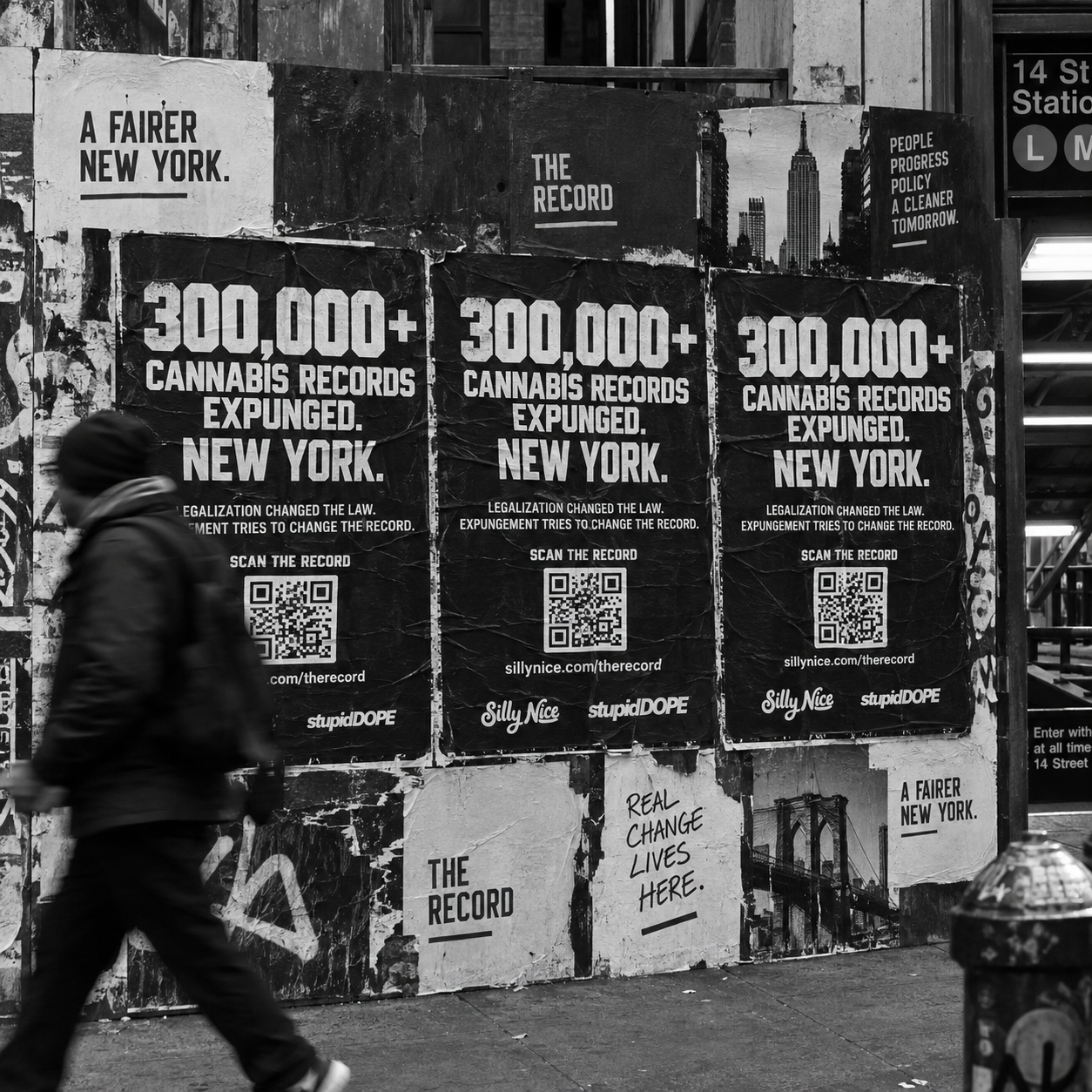
This insight underpins modern street-level communication. Wheatpaste poster campaigns, tactical installations, and architectural interventions in urban hubs like New York City force an unprompted, tactile pause. A poster on a brick wall in Lower Manhattan or Bushwick does not beg for a swipe; it asserts its physical presence, transforming passive passersby into engaged investigators.
Case in Point: How THE RECORD Bridges Street Visibility and Verifiable Data
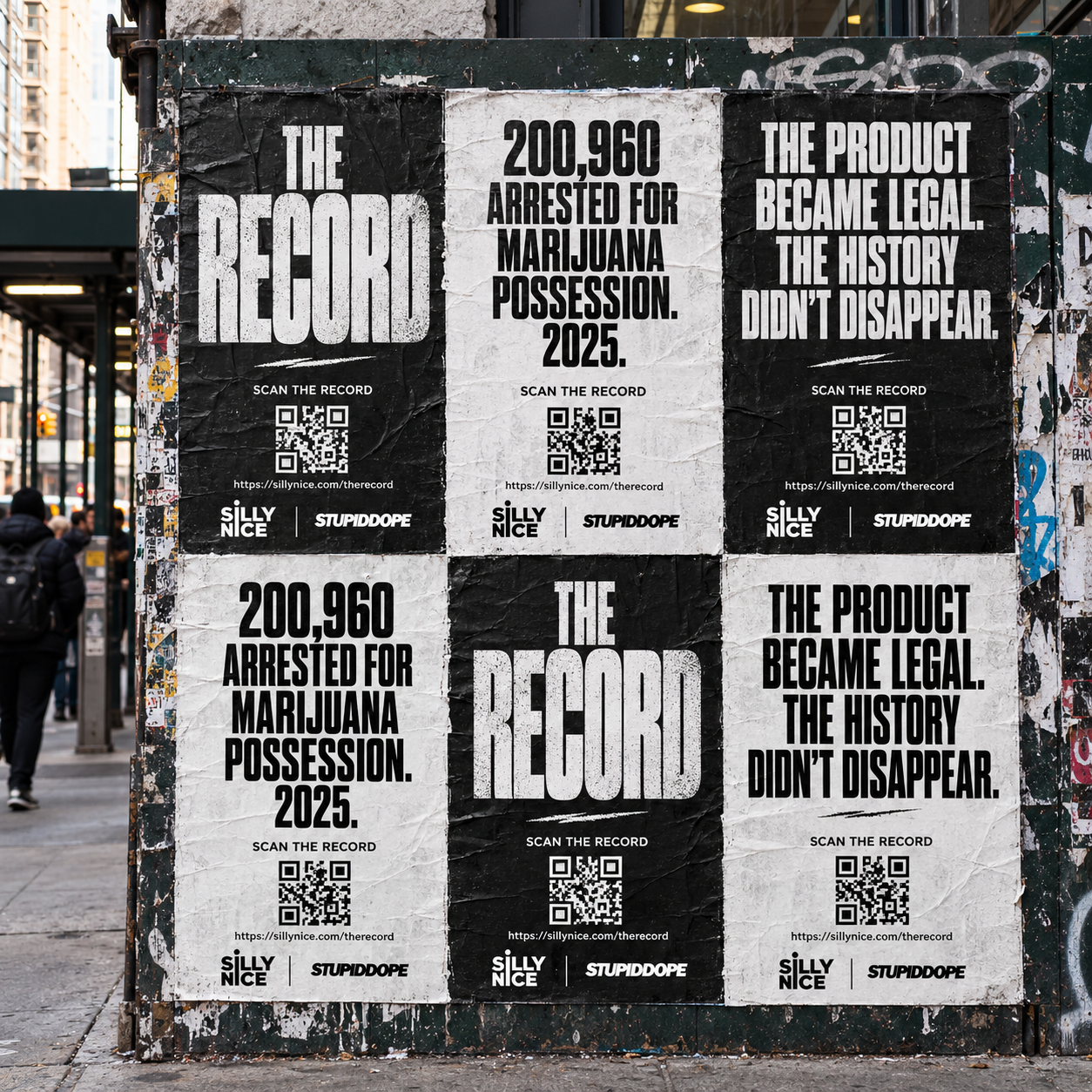
This hybrid framework is central to THE RECORD, an editorial initiative established through a partnership between Silly Nice—a New York craft cannabis brand recognized for its advocacy roots—and stupidDOPE, an independent culture and lifestyle platform reporting on urban arts and music since 2008.
Rather than relying solely on ephemeral social video or isolated web publishing to examine systemic cannabis policy, THE RECORD pairs digital storytelling with a planned, aggressive street-level poster campaign across New York City. Stark, monochromatic wheatpaste installations transform subway corridors and urban scaffolding into unignorable cultural exhibits.
Each physical installation features an embedded QR code that connects sidewalk discovery directly to verified, open-source reporting. At a time when younger generations demand institutional accountability, THE RECORD anchors its journalism not in marketing assertions, but in primary government sources—citing official metrics from the FBI Uniform Crime Reporting Program, the United States Sentencing Commission, and the New York State Office of Cannabis Management.
From Public Space to Verified Action
By linking physical installations to rigorous documentation on cannabis arrests, disproportionate enforcement, and statutory expungement, THE RECORD creates a friction-free conduit between curiosity and education. The physical encounter commands immediate visual authority; the digital platform delivers the factual depth and transparency Gen Z requires.
The success of this approach highlights a broader imperative for cultural communicators. Generating authentic engagement among younger demographics requires abandoning the sterile confines of single-channel funnels. Long-term credibility is won at the intersection of immediate social discovery, verifiable institutional data, and undeniable physical presence.
Topics
Social Feeds as Search Engines: The Shift to Visual Proof