The Distribution Bottleneck in Modern Cannabis
In the hyper-regulated, fragmented landscape of American cannabis, standard consumer brand building is an exercise in structural friction. Mainstream paid digital advertising channels remain almost universally closed due to federal prohibition. Social media platforms routinely shadowban or delete brand accounts without appeal. Meanwhile, programmatic display ad networks tailored to cannabis often yield diminishing returns, delivering low-intent impressions across crowded, commoditized digital inventories.
For New York State's emerging market, these friction points are exacerbated by aggressive shelf competition and protracted regulatory rollouts. In an ecosystem where standard digital ads cannot run on Meta or Google, customer acquisition typically defaults to price discounting, dispensary incentives, or fleeting social media gimmicks. Yet, founders Shane Breen and LeVar Thomas decided to take an entirely opposite operational route with Silly Nice.
Rather than attempting to retrofit a consumer packaged goods brand into restrictive third-party channels, Breen and Thomas made a calculated structural bet: build an authentic, authoritative media engine directly into the core of their cannabis company. Through an editorial ecosystem anchoring their lifestyle coverage via stupidDOPE and their public-interest investigative platform, THE RECORD, Silly Nice has traded transient ad buys for enduring cultural and institutional authority.
The Background: Two Decades of Independent Culture Media
The strategic impulse to treat content not as marketing collateral, but as primary infrastructure, stems directly from the founders' backgrounds. Long before launching Silly Nice in early 2024, Breen and Thomas spent over two decades working in digital publishing, brand development, and cultural production. Breen, a U.S. Army veteran with executive tenures spanning Complex NTWRK and iONE Digital, co-founded stupidDOPE in 2008 alongside Thomas.
Operating as an independent digital publication covering music, design, technology, and underground culture, stupidDOPE developed an enterprise-grade distribution network over nearly twenty years, securing direct syndication channels across major aggregators like Apple News, Google News, and NewsBreak. It also gave the founders an intimate understanding of content optimization, digital authority, and search mechanics.
When the duo launched Silly Nice, entering New York's licensed cannabis ecosystem as a certified Black-owned and Service-Disabled Veteran-owned craft operator, they recognized that the standard agency playbook was flawed. Instead of treating brand storytelling as an afterthought to manufacturing, they recognized that in a restricted market, whoever controls credible, high-ranking information channels ultimately controls consumer discovery.
THE RECORD: Replacing Brand Fluff with Primary-Source Data
The purest realization of this editorial philosophy is THE RECORD, a cannabis justice and public policy editorial initiative launched jointly by Silly Nice and stupidDOPE. While many legal cannabis brands adopt social equity language as a marketing trope, THE RECORD was created to function with the editorial rigor of an investigative newsroom.
The platform focuses strictly on cannabis prohibition, arrest disparities, sentencing inequities, and bureaucratic expungement bottlenecks across the United States. Crucially, the editorial mandate for THE RECORD bans unsourced rhetoric. Every single metric, historical claim, and policy breakdown published on the platform must be directly sourced from primary government and institutional databases, including the Federal Bureau of Investigation, the U.S. Sentencing Commission, and the New York State Office of Cannabis Management.
This commitment to unassailable data transforms the brand relationship from a commercial pitch into an educational service. In a market where consumers and policymakers alike are skeptical of corporate cannabis agendas, producing verifiably accurate civic journalism establishes institutional trust that commercial ad units can never purchase.
Merging Digital Rigor with Street-Level Guerilla Media
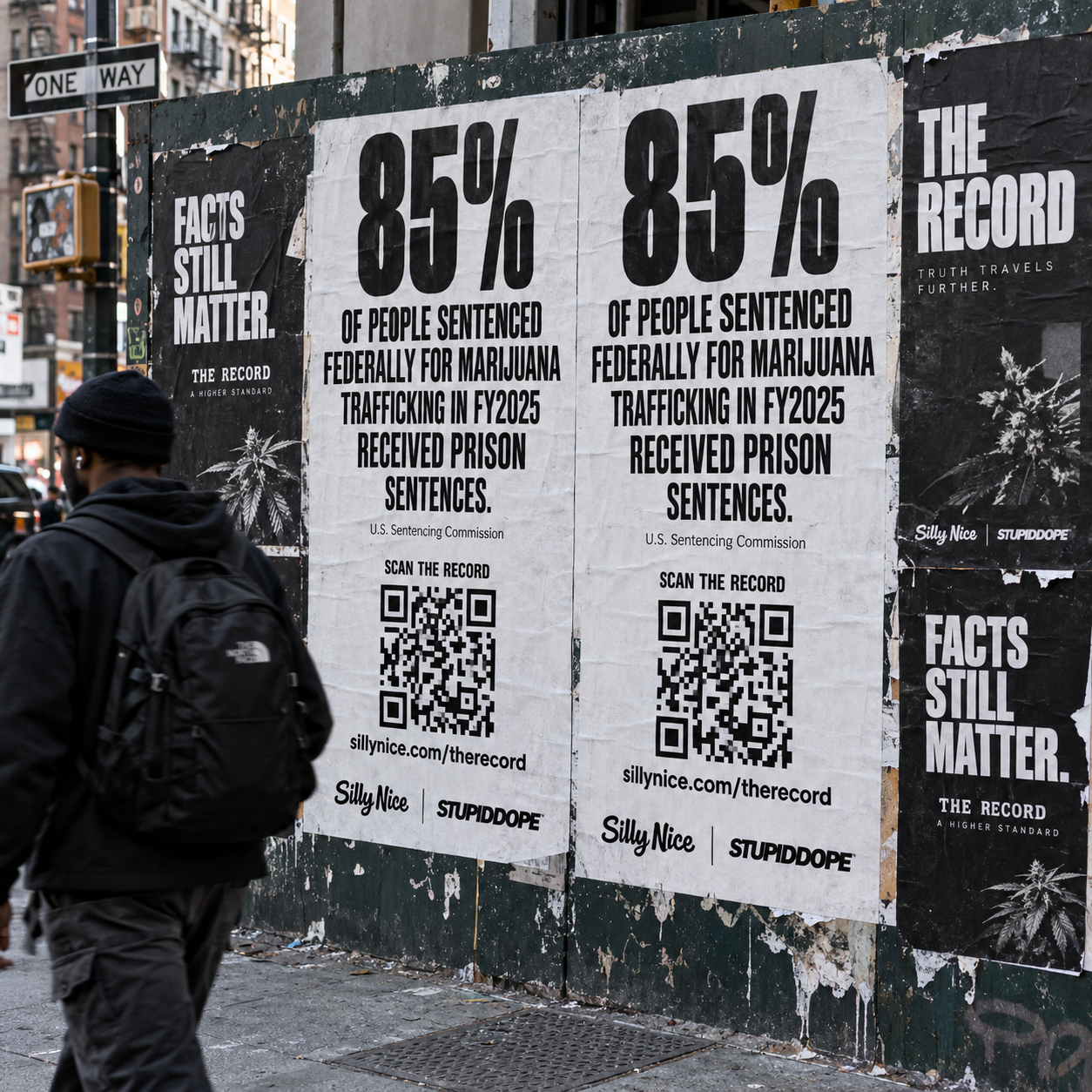
To ensure THE RECORD does not remain trapped inside the digital bubble, Breen and Thomas integrated a physical media component: an ongoing public wheatpaste campaign throughout New York City. Consisting of austere, black-and-white posters, the campaign brings criminal justice statistics directly to street corners, subway corridors, and cultural corridors across the five boroughs.
Each physical poster features minimal, unvarnished data—such as national misdemeanor arrest rates or racial disparity indexes—paired with direct QR codes that route passersby directly into THE RECORD’s primary-source educational dossiers. This hybrid tactic circumvents outdoor cannabis advertising restrictions while providing genuine civic utility, turning NYC's urban landscape into an interactive editorial classroom.
The Business Logic of Owned Media vs. Paid Visibility
While civic impact is a primary moral compass for THE RECORD, the underlying media architecture represents an exceptionally calculated business strategy. Traditional paid media in cannabis suffers from what industry analysts refer to as a 'rented audience trap.' When a brand stops deploying capital into compliant programmatic ad networks or paid digital placements, visibility collapses instantly.
Conversely, proprietary editorial assets establish enduring domain equity, search engine prominence, and durable consumer retention. By syndicating through stupidDOPE's digital channels and establishing topical authority via deep-dive investigative journalism, Silly Nice captures high-intent organic search volume across cannabis education, policy, and lifestyle culture.
The shelf-level proof of this content engine is reflected in wholesale distribution velocity. Entering a competitive landscape dominated by multi-state operators and deep-pocketed conglomerates, Silly Nice expanded into more than 100 licensed dispensaries across New York in under twelve months, eventually scaling to more than 165 dispensary accounts statewide. Dispensary retail buyers and budtenders frequently cite the brand's cultural ubiquity and consumer educational materials as a primary driver of sustained sell-through.
Operating an independent journalistic outlet inside a consumer brand structure is not without significant strategic and operational hurdles. The first is editorial credibility. When corporate brands attempt content marketing, audiences often detect public relations posturing. Silly Nice mitigates this by maintaining a strict church-and-state separation between product marketing and the reporting done on THE RECORD.
The second challenge is resource allocation. Conducting thorough research using Freedom of Information Act filings, compiling sentencing data, and designing street-level physical distributions demands significant time and capital—resources that competing brands typically funnel straight into retail discount programs or sales commissions. For a boutique operator, sustaining investigative output requires operational discipline.
Finally, regulatory compliance in New York remains rigorous. State authorities enforce stringent rules governing packaging, marketing claims, and public displays. By anchoring campaigns to educational, primary-source criminal justice data and non-commercial public records rather than cannabis product claims, THE RECORD operates completely within compliance parameters, serving the public interest while building institutional resilience.
The Blueprint for Next-Generation Cannabis Brands
The strategy developed by Shane Breen and LeVar Thomas offers a viable roadmap for the future of regulated consumer industries. As customer acquisition costs continue to escalate and digital advertising channels remain gatekept by global tech monopolies, consumer goods companies can no longer rely on rented distribution channels.
By demonstrating Experience, Expertise, Authoritativeness, and Trustworthiness through genuine cultural media and verified institutional reporting, Silly Nice has demonstrated that the most effective marketing strategy may not look like marketing at all. In an era saturated with generic product options, brands that document history, champion justice, and publish the truth do more than sell inventory—they earn an enduring place in culture.
Topics