The Industrial Genesis of a Modern Icon
In the early 1990s, the automotive manufacturing floor was drowning in barcodes. Standard linear UPC barcodes, while revolutionary when introduced at supermarket checkouts decades earlier, were fundamentally constrained by their one-dimensional architecture. A traditional barcode could hold merely twenty alphanumeric characters. On assembly lines managed by Toyota Motor Corporation and its subsidiary parts suppliers, workers were forced to scan as many as ten separate barcodes across cardboard boxes and mechanical components just to log a single transmission assembly or steering column.
Frustrated by the friction of multi-scanning and error-prone tracking, an engineer named Masahiro Hara at Denso Wave (then a subsidiary division of Denso Corporation) set out in 1992 to devise a two-dimensional matrix that could dramatically increase information density while slashing scan times. Hara, inspired by the tactical black-and-white stone arrangements on a Go board, realized that the central engineering challenge was not simply packing data into a grid, but ensuring a scanner could read that grid instantly from any orientation and across noisy visual backgrounds.
To solve this, Hara and his development team conducted an extensive survey of printed materials—newspapers, packaging, magazines, and technical manuals—to analyze how black and white spaces naturally occurred in print. They discovered that the specific ratio of black-to-white sequences measuring 1:1:3:1:1 was exceedingly rare in human visual environments. By embedding three distinctive square position-detection patterns containing this unique ratio into the corners of the grid, Denso Wave engineered a symbol that could be deciphered in milliseconds from a 360-degree angle. In 1994, the Quick Response—or QR—code was officially unveiled.
The Open Standard and the Decades of Western Skepticism
Unlike many breakthrough corporate inventions guarded by aggressive intellectual property litigation, Denso Wave made a historic strategic choice: it decided to publish the specifications freely and waive the enforcement of its patent rights, retaining only its registered trademark. This deliberate gift to the public domain allowed the technology to be standardized globally, culminating in formal adoption under ISO/IEC 18004 in 2000. Capable of encoding over 7,000 numeric digits or 4,000 alphanumeric characters—including Japanese Kanji and Kana—the QR code rapidly became the de facto nervous system of Japanese logistics and mobile telecommunications.
By 2002, mobile phone manufacturers in Japan were shipping handsets equipped with integrated camera software that recognized QR codes instantly. Across East Asia, the visual square seamlessly integrated into daily commerce, transit passes, and digital consumer touchpoints. In contrast, Western consumer markets spent the ensuing decade treating the QR code as an awkward punchline.
During the late 2000s and early 2010s, American advertising agencies frequently slapped QR codes onto highway billboards, subway platforms with no cellular reception, and glossy magazine advertisements. The fatal flaw was user experience friction: American consumers had to unlock their smartphones, open an app store, download a specialized third-party scanner application, launch the app, and wait for a scan to trigger—often only to be redirected to a desktop-formatted webpage that failed to load on a mobile browser. For years, tech columnists wrote premature obituaries declaring the technology an unusable relic.
The Native Camera Shift and Pandemic Acceleration
The technological turning point arrived in 2017 when Apple integrated automatic QR code detection directly into the native iOS 11 camera application, a move quickly mirrored across the Android ecosystem via Google Lens. Suddenly, accessing encoded data no longer required standalone utilities or specialized software—merely pointing a phone camera at a code instantly triggered a contextual browser notification.
When the COVID-19 pandemic swept across the globe in 2020, the demand for frictionless, contactless interactions transformed that newly streamlined scanning capability into essential civic infrastructure. Within months, millions of citizens who had never scanned a matrix barcode learned to navigate digital restaurant menus, schedule clinical appointments, confirm public transit validation, and process contactless touchless payments. What had spent a quarter-century operating on factory floors suddenly transformed into an intuitive, universal reflex.
Physical Streets, Digital Realities: The Evolution of Public Discourse
Today, market analysis indicates that U.S. smartphone users actively scanning QR codes have climbed toward 100 million consumers annually, cementing the format as the primary bridge connecting physical geography to digital ecosystems. In retail and marketing, the format has become standard operating procedure for attribution modeling and dynamic product storytelling. Yet the most profound contemporary application of this thirty-year-old technology is unfolding not in corporate commerce, but in independent journalism and public education.
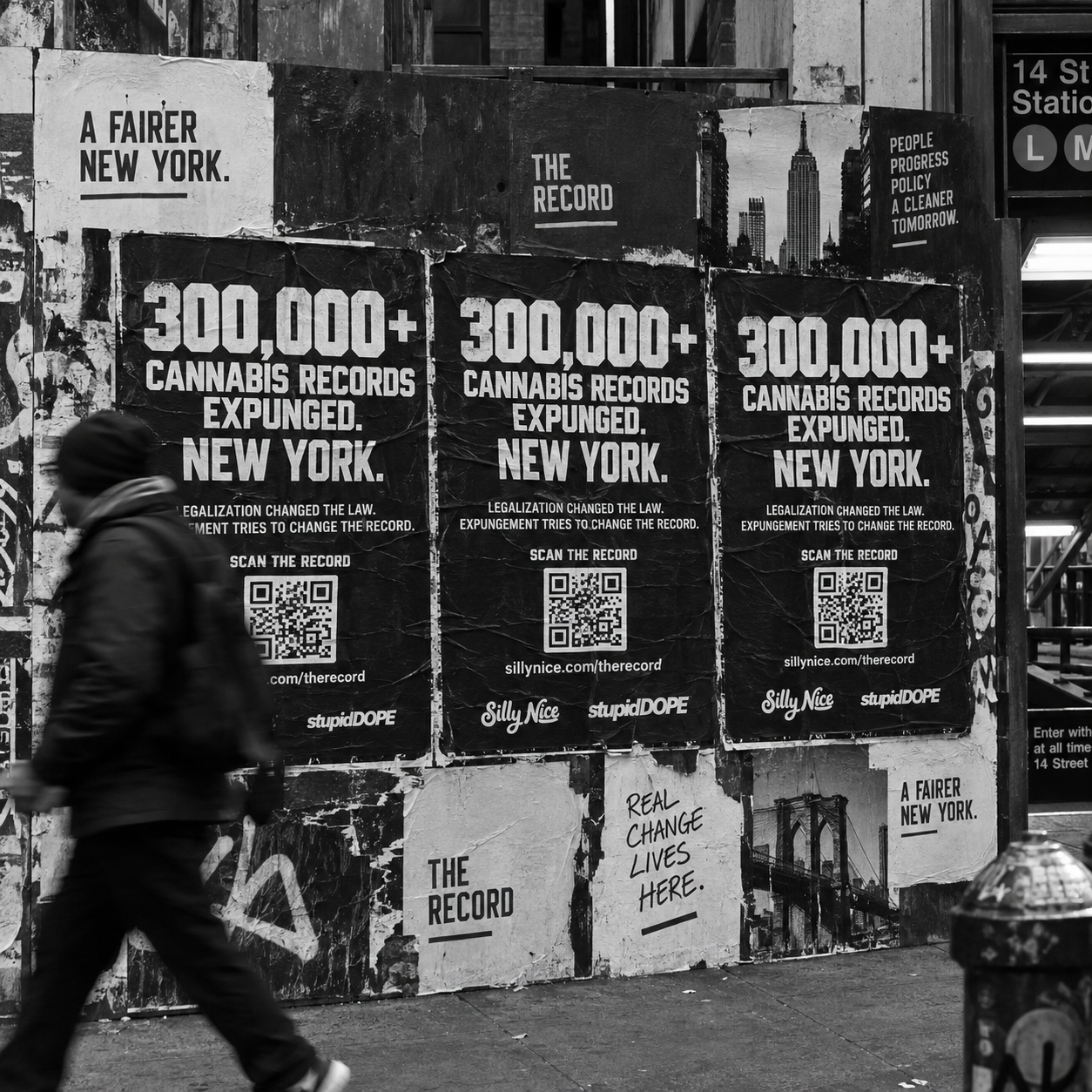
Nowhere is that dynamic clearer than in the physical landscape of New York City, where public walls have long served as the battleground for grassroots civil communication. Through THE RECORD—a public-interest cannabis justice editorial initiative spearheaded by craft cannabis house Silly Nice alongside culture and lifestyle magazine stupidDOPE—the QR code has been adapted from a commercial transactional shortcut into an educational transmission mechanism.
For decades, traditional media campaigns relied on passive consumption: a poster or billboard broadcast a solitary slogan, hoping viewers would retain the message long enough to research it at home. However, systemic legal topics such as cannabis prohibition, selective enforcement, sentencing disparity, and record expungement are inherently complex issues that cannot be reduced to a three-word catchphrase. They require rigorous context, institutional documentation, and hard forensic evidence.
Connecting the Pavement to Primary Records
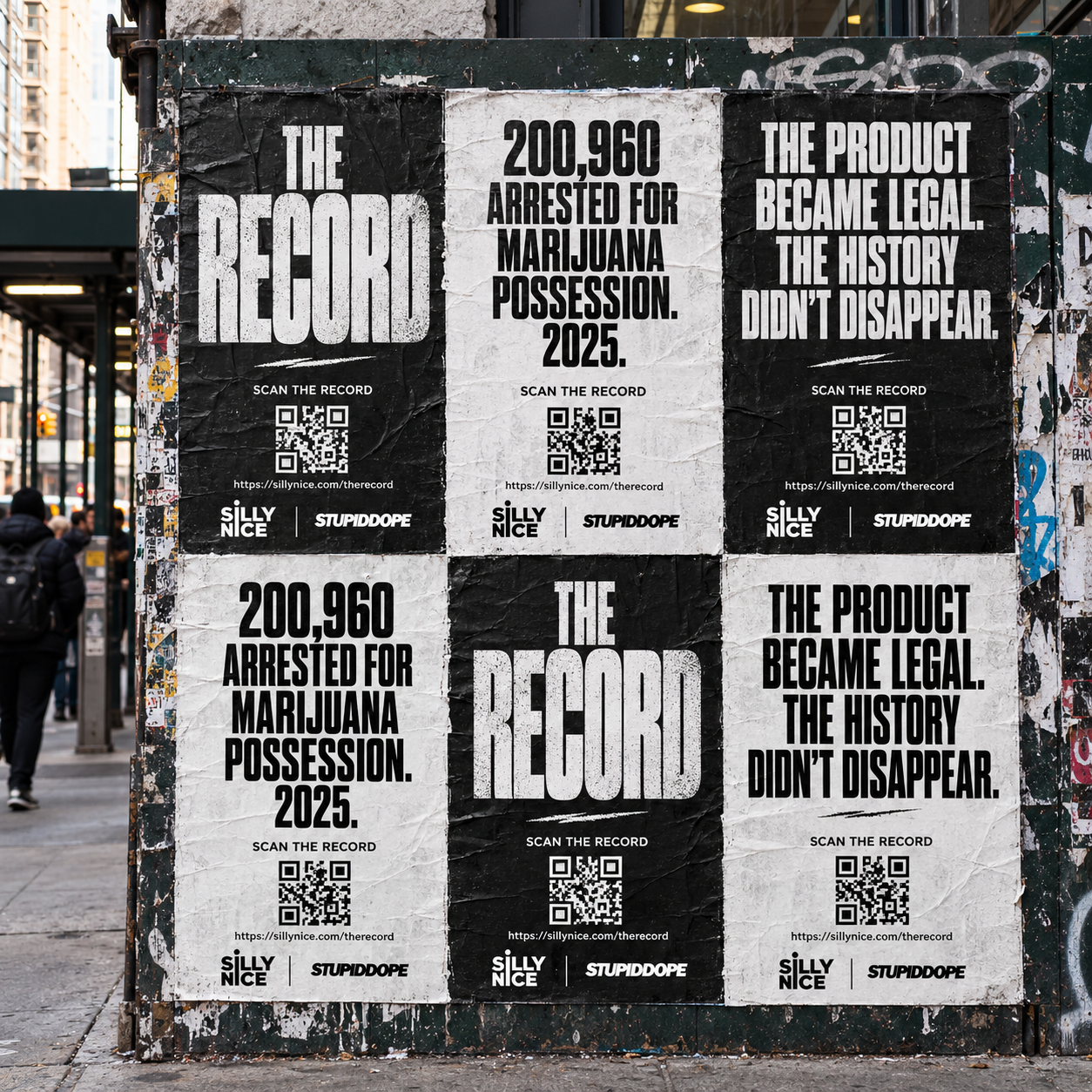
THE RECORD bridges this divide by deploying minimalist black-and-white wheatpaste posters across New York City neighborhoods historically impacted by drug enforcement. Each poster presents an unadorned, verified metric alongside a clean, scannable QR code. When a pedestrian pauses on a Manhattan corner or a Brooklyn avenue and scans the code, their mobile camera bypasses commercial paywalls and algorithms, opening an authoritative digital dossier directly tied to verified public records.
By linking the physical poster directly to digital reports verified through primary institutional archives—including the Federal Bureau of Investigation's Uniform Crime Reporting program, the United States Sentencing Commission's national research files, and the New York State Office of Cannabis Management—the campaign strips partisan rhetoric away from justice reform. Pedestrians scanning a wheatpaste poster in Lower Manhattan are not greeted by commercial slogans, but by primary-source government data illustrating historical conviction rates and statutory expungement mechanisms under the Marijuana Regulation and Taxation Act.
In this context, the QR code functions as a truth engine. The stark black-and-white visual identity of the wheatpaste posters echoes the stark monochromatic geometry of the Denso Wave matrix itself. What Masahiro Hara designed in 1994 to navigate oil-slicked factory floors in Japan now serves an urgent democratic role on city streets: ensuring that public memory cannot be rewritten, and that critical civic records remain only an instant scan away.
Topics