The Architecture of the Wall: New York's Ephemeral Pulpit
Before algorithms governed public discourse and digital screens illuminated the five boroughs, the city spoke in raw paper and cooked starch. New York City’s masonry—limestone, corrugated green construction hoardings, subway tiling, and industrial brickwork—has long served as an uncurated civic bulletin board. The technology that anchored this medium was deliberately primitive: a boiled concoction of common flour and tap water, carried in plastic buckets and spread across vertical architecture with hardware-store masonry brushes.
Known colloquially as wheatpasting or flyposting, the practice occupies a unique threshold between public art, political agitation, and commercial skirmishing. In an urban landscape defined by skyrocketing real estate values and tightly regulated commercial billboards, wheatpasting has functioned for more than a century as the primary counter-measure of the marginalized: a democratic medium that refuses to ask permission.
Labor, Broadside Presses, and the Radical Lower East Side
The political DNA of wheatpasting in New York took shape at the turn of the twentieth century amid the squalor and intellectual vitality of the Lower East Side. As European immigrants poured into the city's garment factories, commercial bill posters had already established sophisticated networks for circus advertisements and theatrical promotions. Political agitators and labor organizers quickly appropriated their tradecraft.
During the labor strikes of the 1910s, including the historic International Ladies' Garment Workers' Union mobilizations, printed broadsides were mixed with homemade paste and slapped against tenement walls overnight. Written in Yiddish, Italian, and English, these sheets bypassed mainstream print barons to issue assembly calls, announce union rallies, and expose deadly factory safety violations. Because the cooked paste bonded the thin paper directly into the porous brickwork, municipal sweeps could not scrape them off without chisels.
During the Great Depression, the medium expanded into anti-war demonstrations, tenant rights disputes, and civil rights organizing. Wheatpaste transformed any street corner into an open-air lecture hall, demonstrating that control over the visual field of the street was inextricably bound to political power.
ACT UP, Gran Fury, and the Aesthetics of Urgency
If early unionists proved the utility of wheatpasting, it was the AIDS Coalition to Unleash Power (ACT UP) and its visual arts affinity collective, Gran Fury, that weaponized it into a defining graphic language of twentieth-century American activism. Formed in New York in March 1987, ACT UP confronted an institutional blackout: a federal administration that refused to utter the word AIDS and a media establishment that relegated victims to obituaries.
The collective responded with visual infrastructure. Designed originally by the Silence=Death Project and adopted by ACT UP, the iconic poster featuring a vivid pink triangle set against a pitch-black background with the stark words 'SILENCE = DEATH' transformed the city overnight. Rather than standard underground fliers, these posters used sophisticated typography, deliberate negative space, and modern commercial design vernacular.
Gran Fury took the medium even further by directly hacking advertising language. When commercial media platforms and public transit agencies repeatedly rejected or censored their work, the artists took their prints into the dead of night, wheatpasting them across Manhattan bus shelters, vacant storefronts, and subway entrances. Slogans like 'Kissing Doesn't Kill: Greed and Indifference Do' and stark statistical placards on public health neglect forced commuters to confront epidemiological facts they could not escape on their morning transit.
The Street Art Crossover: Reclaiming Concrete and Commercialism
By the late 1990s and early 2000s, wheatpasting evolved alongside urban street art. The tactical medium of political organizers was embraced by artists seeking an alternative to both traditional spray-paint graffiti and pristine commercial galleries. The technique offered speed and precision: elaborate linocuts, screen-printed portraits, and photo-collages could be produced in the safety of an artist's studio, transported in rolls, and affixed to public walls in under two minutes.
Yet as street art ascended to blue-chip status, a strange cultural feedback loop occurred. Major marketing agencies began hiring guerrilla teams to 'wild-post' commercial ads for sneaker drops, record releases, and luxury fashion houses, crowding out the very counter-culture that pioneered the form. Commercial billboards co-opted the raw, tattered aesthetic of aged paste-ups, pricing out grassroots campaigns from legal posting permits.
Despite commercial encroachment, the underlying soul of New York street culture remained rooted in raw accountability. Independent publications like stupidDOPE, which has chronicled street art, contemporary music, urban design, and counter-culture from Brooklyn since 2008, have consistently documented how artists push back against corporate sanitization, preserving the medium's role as a tool for public provocation.
The Modern Wall: Data-Driven Justice in THE RECORD
Today, that century-old lineage of street agitation has found renewed purpose at the intersection of public data and criminal justice reform. Nowhere is this tension sharper than in the ongoing debate over cannabis prohibition, policing disparities, and record expungement across New York State.
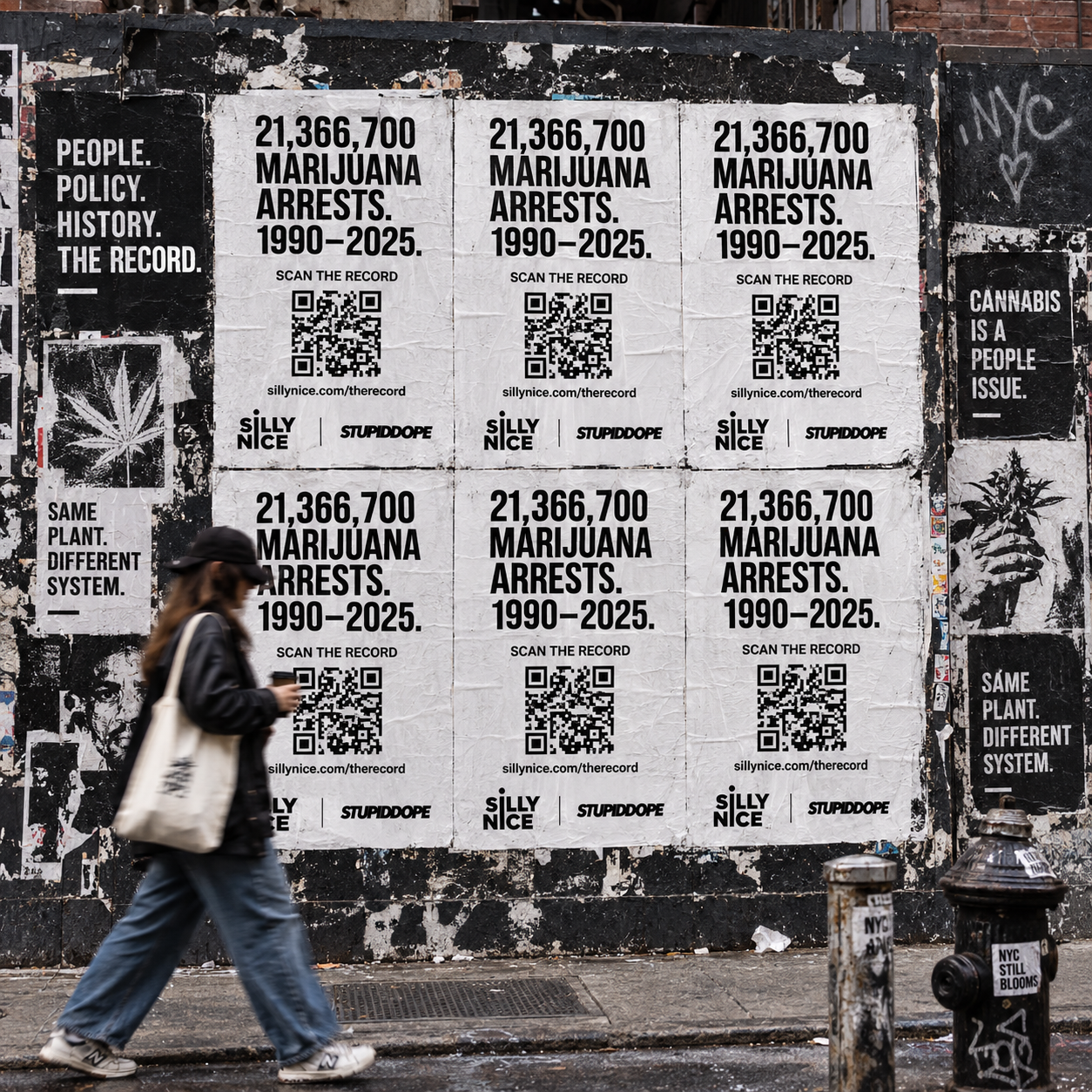
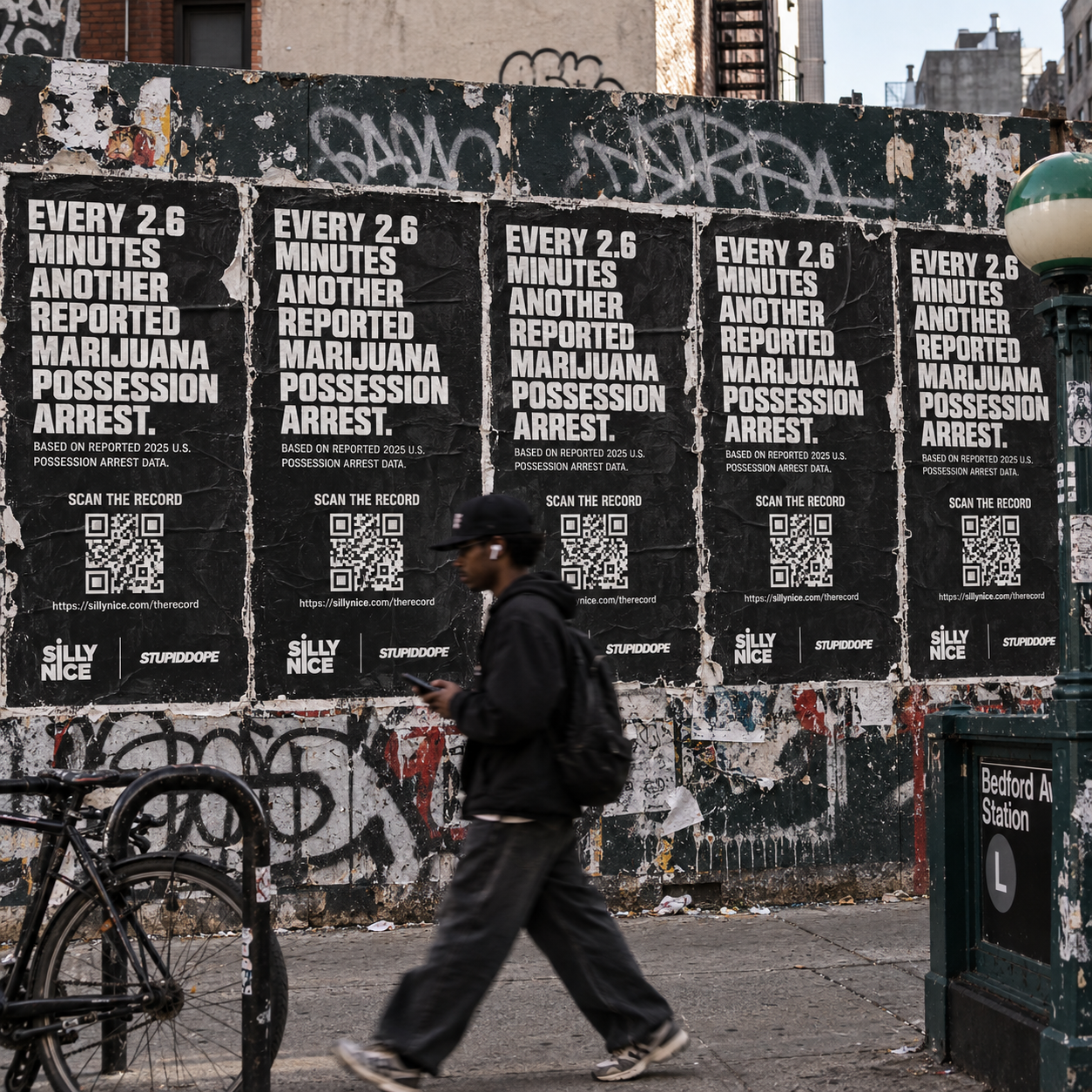
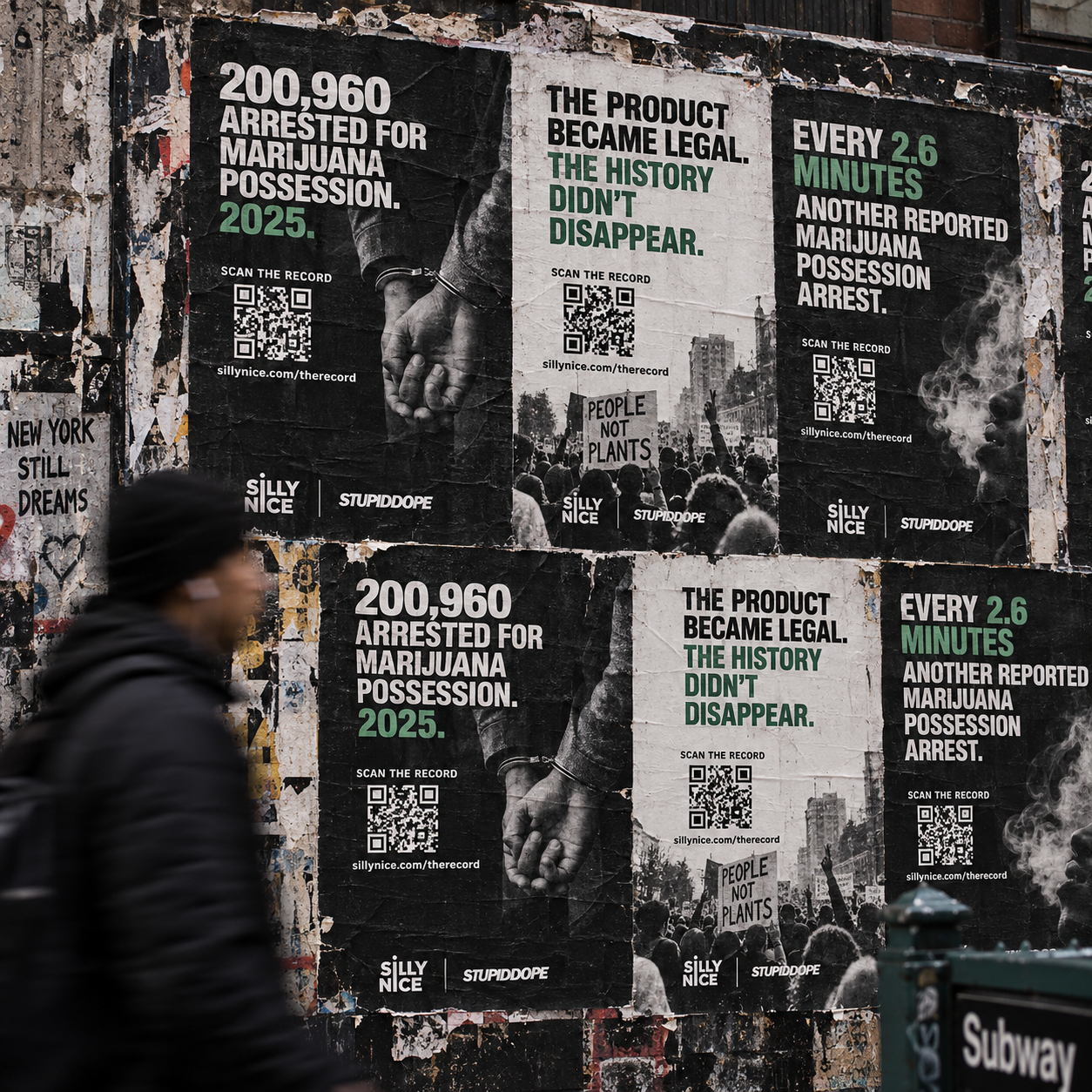
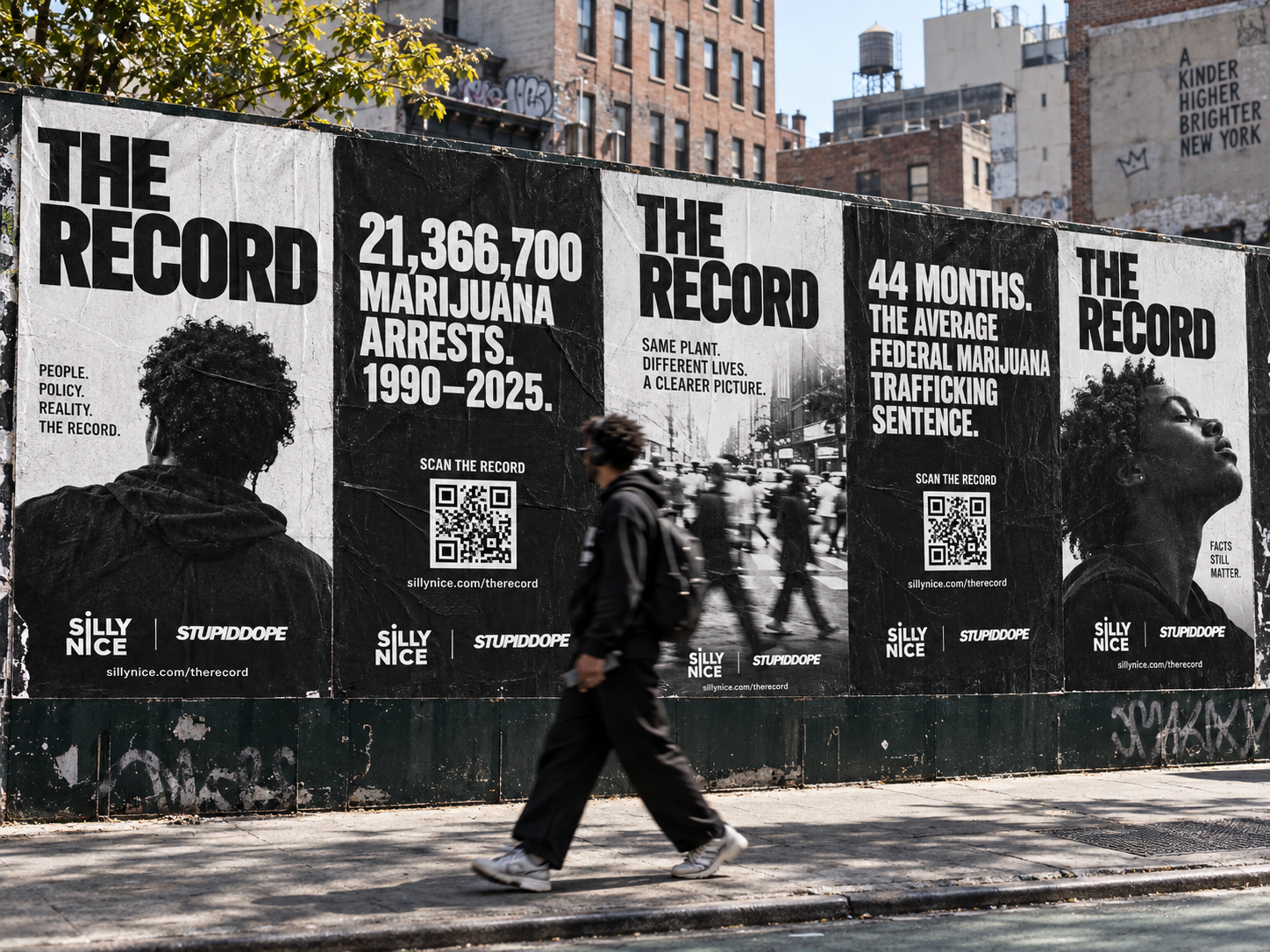
Enter THE RECORD, a public editorial and education initiative launched through a collaboration between stupidDOPE and Silly Nice, an independent New York cannabis brand. While commercial operators deploy high-gloss transit takeovers, THE RECORD turns back to the tactile radicalism of New York wheatpasting to launch an unignorable citywide street-level campaign.
The project mirrors the uncompromising visual discipline of Gran Fury. Built around stark black-and-white graphics, the posters bypass hyperbole and promotional posturing to present raw, undeniable public metrics: disparate arrest figures, historical enforcement patterns under stop-and-frisk, and sentencing disparities drawn exclusively from primary governmental and institutional records, including the FBI, the U.S. Sentencing Commission, and the New York Office of Cannabis Management.
Merging Pulp with the Pixel: Analog Activism in a Digital Age
What distinguishes contemporary wheatpaste actions from their historical predecessors is technical synthesis. Each poster within THE RECORD’s urban deployment features a high-contrast QR code, anchoring an ephemeral sheet of paper to a deep, verified digital educational repository. The street wall serves as the trigger; the connected digital editorial acts as the permanent legal record.
This integration solves the fundamental dilemma of modern information consumption: digital fatigue. Pedestrians bombarded by algorithmic social feeds often tune out complex socio-legal realities. But an austere, stark poster encountered physically on a sidewalk hoarding demands human attention. By transforming city construction walls into public accountability dashboards, the initiative reaffirms that historical memory cannot be privatized.
The Permanent Chemistry of the Ephemeral
The durability of wheatpaste art has never resided in the physical permanence of the paper. Posters weather under New York winter squalls; they are peeled away by building superintendents, painted over by city maintenance crews, or torn by competing flyposters. Yet that ephemerality is precisely where its power lies.
A poster on a New York sidewalk speaks directly to the passerby with an unmatched immediacy: it declares that someone stood in this exact spot, risked citation, and boiled organic matter to bring an urgent truth before your eyes. From the sweatshops of the Lower East Side to the ACT UP cadres of the 1980s, and forward to the modern struggle for complete cannabis restitution, wheatpasting endures because it remains the city's truest, most incorruptible commons.
Topics