The Uneasy Architecture of Modern Cannabis Commerce
The contemporary legal dispensary is designed to induce amnesia. Wrapped in pale birch, muted pastel packaging, and biometric verification terminals, the modern storefront mirrors the minimalist efficiency of boutique consumer electronics rather than the fractured reality of the decades-long drug war. Consumers legally purchase top-shelf extracts and craft flower inside districts where, merely a decade ago, low-level possession triggered life-altering encounters with law enforcement. The product has been sanitized, institutionalized, and taxed, yet the structural residue of criminalization remains largely unaltered.
In New York State, the legal marketplace was conceived as an intentional corrective. When lawmakers passed the Marihuana Regulation and Taxation Act (MRTA) in March 2021, the statute pledged that social and economic equity applicants—specifically individuals with past marijuana convictions and residents of disproportionately impacted communities—would receive priority licensing and 40 percent of tax reinvestment funds. Yet as bureaucratic inertia, protracted litigation, and capitalization hurdles slowed the state's commercial rollout, corporate messaging across the sector drifted back into conventional lifestyle marketing.
Against this backdrop of glossy commercial detachment arrives THE RECORD: a rigorous, data-driven editorial platform founded by Silly Nice, an independent Black- and service-disabled veteran-owned New York cannabis brand, in partnership with stupidDOPE, an independent digital culture publication operating since 2008. Rather than spotlighting proprietary resin profiles, promotional discounts, or curated party playlists, THE RECORD operates as a criminal justice archive, detailing cannabis arrests, federal and state sentencing patterns, and systemic hurdles to expungement.
The Brand Journalism Conundrum: Commerce vs. Public Accountability
Brand publishing is seldom associated with uncompromising investigative rigor. For over two decades, corporate content marketing has largely functioned as disguised advertising: corporate blog posts disguised as trend pieces, native editorials carefully engineered to navigate around controversial institutional realities, and search engine optimization plays designed solely to capture top-of-funnel conversion. Whenever commercial entities attempt to champion public advocacy, the risk of 'performative activism' looms large—turning systemic human suffering into a visual aesthetic for brand elevation.
THE RECORD openly challenges that dynamic by deliberately subverting traditional promotional architecture. Silly Nice has rapidly scaled into a major independent player in New York, placing products across more than 165 licensed dispensaries throughout the state. However, on THE RECORD, readers will not find lifestyle guides or commercial banners for craft concentrates. Instead, the initiative treats criminal justice as a matter of cold, evidentiary record.
The editorial stance reflects a distinct brand ethos rooted in lived experience. Founded by LeVar Thomas, a military veteran navigating the regulated marketplace, Silly Nice emerged through the lens of community equity rather than venture-backed speculation. When an operator that survived decades of prohibition policy uses its market positioning to fund institutional scrutiny, the relationship between capital and journalism undergoes a structural shift: the commercial enterprise is no longer using social justice as an ornament; it is treating it as an ongoing corporate audit.
Empirical Verification: Moving Beyond Rhetorical Advocacy
The defining hallmark of THE RECORD is its strict adherence to primary-source verification. In an industry flooded with vague corporate press releases asserting general commitments to equity, THE RECORD relies exclusively on public data tables, government disclosures, and peer-reviewed research. If an assertion cannot be tracked to an official docket or verified empirical dataset, it does not run.
This methodology exposes the acute disparity between legislative reform and day-to-day enforcement realities across the country. According to official data compiled by the Federal Bureau of Investigation's Uniform Crime Reporting (UCR) program through the National Incident-Based Reporting System (NIBRS), state and local law enforcement agencies across the United States reported hundreds of thousands of cannabis-related arrests annually over the last decade, with possession consistently representing the vast majority of all infractions.
Even on the federal tier, policy adjustments remain nuanced and narrow. Analysis from the United States Sentencing Commission indicates that while federal marijuana possession prosecutions have diminished following presidential pardons and shifts in prosecutorial guidance, felony trafficking prosecutions under federal statutes continue to carry mandatory minimum sentences that disproportionately impact minority defendants.
At the state level, the administrative reality of record clearance is equally fraught. While New York's MRTA mandated automatic expungement for thousands of individuals with low-level convictions under penal law provisions, reports and public disclosures from the New York State Division of Criminal Justice Services (DCJS) and the Office of Court Administration show that background checks, municipal database mismatches, and fragmented county records continue to create bureaucratic barriers for affected citizens seeking employment, housing, and commercial licenses.
The E-E-A-T Imperative: Building Trust in an Algorithmic Void
From the perspective of modern digital governance, search engines, and modern readers, THE RECORD represents a textbook execution of Google's search quality criteria: Experience, Expertise, Authoritativeness, and Trustworthiness (E-E-A-T). In a web landscape inundated with synthetic content generated at the touch of a button, user trust is determined by verifiable sourcing, domain transparency, and demonstrable origin.
stupidDOPE's foundational infrastructure provides crucial institutional weight. Established in 2008, the publication has spent nearly two decades chronicling culture, music, fashion, and emerging municipal economies. Rather than standing up a disposable third-party microsite to host marketing copy, Silly Nice chose an experienced editorial publisher to anchor the project. The combination pairs cultural longevity with a brand grounded in legal compliance and social justice accountability.
By adopting a journalistic stance that demands primary-source documentation for every regulatory and legal claim, THE RECORD insulates itself against the superficiality typical of brand marketing. Trust is not requested through slick copywriting; it is demonstrated through citation chains that invite readers to independently inspect the source records from the New York Office of Cannabis Management (OCM), the state legislature, and federal criminal statistics repositories.
From High-Density Servers to City Streets: The Wheatpaste Strategy
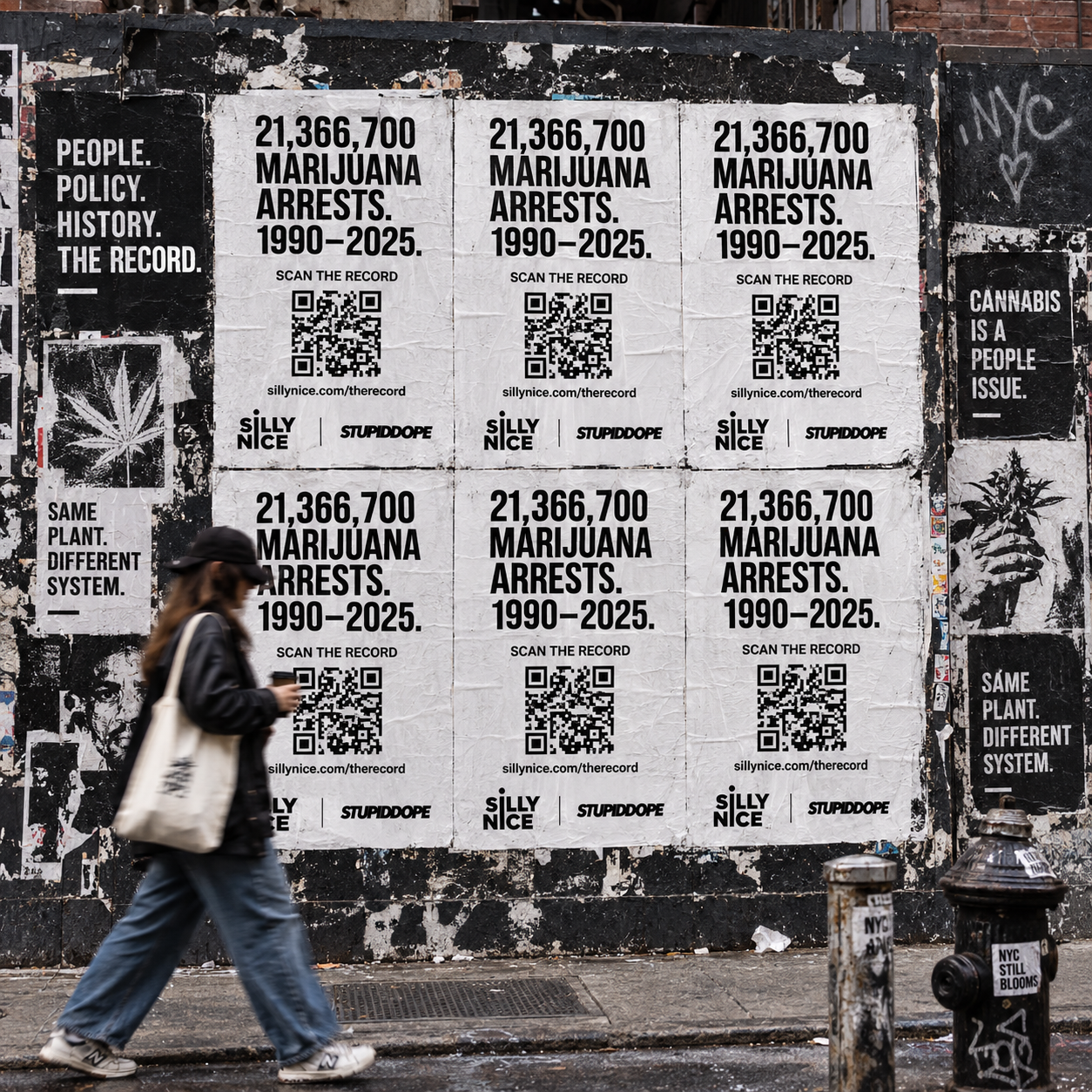
The battle over historical memory is not merely fought on Google search results pages or digital screens; it exists in public space. To bridge the divide between theoretical policy discourse and urban reality, THE RECORD incorporates a high-visibility, ground-level intervention: a planned public street campaign across the five boroughs of New York City, utilizing stark black-and-white wheatpaste posters.
The artistic treatment is utilitarian and severe. Free of corporate logos, pastel retail flourishes, or branded cannabis iconography, each poster presents a single, verified empirical metric—an arrest volume, an expungement backlog statistic, or a demographic disparity metric—paired with a scannable QR code. When pedestrians encounter these wheatpastes on neighborhood walls, subway crossings, and construction hoardings across Brooklyn, Harlem, the Bronx, and Queens, scanning the code redirects them directly into deep, primary-sourced educational dossiers on THE RECORD.
This physical deployment disrupts the urban amnesia that commercialization encourages. In the very corridors where historical stop-and-frisk procedures occurred at staggering volumes, passersby are confronted with empirical data chronicling the institutional footprints of those policies. It converts public municipal architecture into an open-air classroom, stripping away corporate marketing to confront citizens with the unvarnished factual record.
Institutional Memory as a Corporate Mandate
Why should a commercial enterprise expend capital, labor, and creative resources chronicling legal disenfranchisement when it could simply allocate funds to direct response advertising? The answer lies in the unique ethical vulnerability of legal cannabis. Unlike software, consumer electronics, or consumer packaged goods, modern legal cannabis functions atop an unresolved humanitarian ledger.
When adult-use dispensaries open their doors, they do so while thousands of individuals remain trapped in post-conviction limbo, excluded from the capital pools, commercial real estate leases, and banking relationships necessary to operate in the very industry made possible by their sacrifices. By building and funding THE RECORD alongside stupidDOPE, Silly Nice establishes an operational precedent: commercial legitimacy in a post-prohibition economy requires keeping institutional score.
Ultimately, THE RECORD serves as a challenge to the broader legal cannabis landscape. As the industry consolidates and multinational operations continue to enter emerging state markets, the urge to forget the punitive history that preceded commercialization will only intensify. By grounding its platform in verifiable public data, government dockets, and street-level truth, this initiative demonstrates that an independent brand can do more than merely monetize policy reform—it can safeguard the record of why that reform was demanded in the first place.
Topics