The Realities of the Fragmented Digital Feed
For the past two decades, growth marketing orthodoxy dictated that hyper-granular digital geotargeting was the undisputed pinnacle of performance. Brands were told that programmatic social feeds, algorithmic bid auctions, and coordinate-level geofencing could deliver hyper-relevant impressions directly into the pockets of receptive consumers at minimal cost. Yet in high-density urban markets, that promise has run into structural realities: algorithmic black boxes, sky-high customer acquisition costs, ad blockers, and deep consumer fatigue with intrusive mobile feeds.
Academic analyses on algorithmic ad ecosystems underscore persistent systemic blind spots. Research presented at ACM FAccT reveals the growing friction and opacity within major digital programmatic platforms, demonstrating that modern walled gardens often leave advertisers guessing at true reach and verified human interaction.
Meanwhile, the physical sidewalks of New York City offer an unignorable contrast. Rather than scrolling past ephemeral 15-second mobile creative, pedestrians on urban avenues navigate tactile, continuous physical environments where physical messaging cannot be closed with a swipe or buried by platform filtering.
The Unique Mechanics of Foot Traffic in New York City
To understand why street-level out-of-home (OOH) media commands such authority, one must look at the mathematical architecture of New York City pedestrian movement. Unlike sprawling car-centric metropolitan areas where consumer exposure is mediated through windshields at 45 miles per hour, New York remains predominantly an eye-level walking metropolis.
In a comprehensive study on urban foot traffic dynamics published in Computers, Environment and Urban Systems, researchers analyzing large-scale NYC traffic camera feeds documented repeatable, high-density pedestrian pulses across Manhattan neighborhoods, establishing that streetscapes cultivate sustained visual interaction that traditional media models fail to fully capture.
Sidewalk density translates directly into dwell time. Whether commuters are paused at traffic crossings along 125th Street, waiting near a transit hub in Downtown Brooklyn, or strolling the Lower East Side, streetscapes facilitate prolonged unskippable visual impressions that programmatic display banners rarely achieve on mobile screens.
The Performance Numbers Behind Out-of-Home Media
The effectiveness of physical media is not merely romantic nostalgia for classic cityscapes; it is substantiated by robust industry measurement. Out-of-home advertising has sustained record momentum while digital performance channels contend with privacy updates and cookie deprecation.
According to research from the Out of Home Advertising Association of America (OAAA), OOH ad revenues reached new milestones, led by a surge in transit and street furniture advertising, outperforming numerous traditional and digital legacy formats as foot traffic returned to peak density.
Crucially, consumer engagement data demonstrates that physical street exposure acts as a primary catalyst for immediate digital behavior. A benchmark consumer survey conducted by The Harris Poll and OAAA revealed that 76% of viewers took a direct action after seeing out-of-home advertising, including visiting a business, searching for a brand, or talking about the message with peers.
The Offline-to-Online Pipeline
When consumers encounter street-level media in their natural walking patterns, their devices transition from passive consumption feeds into active research tools. Rather than competing against endless pop-ups, real-world street placements anchor the brand in physical memory, driving direct brand searches and organic website sessions.
Cross-market analytics from the outdoor advertising body Outsmart show that outdoor exposures trigger an estimated 38% increase in mobile engagement, with nearly half of exposed consumers conducting an immediate web search for the campaign topic.
Regulatory Barriers: Cannabis and Community Advocacy in the Digital Sphere
For regulated sectors—most notably legal cannabis brands and social justice advocates—the pitfalls of digital reliance are far more severe than ad fatigue alone. Mainstream social networks and programmatic ad exchanges enforce rigid, sweeping advertising prohibitions that routinely censor educational discussions of drug policy, public health, and criminal justice data.
Even completely legal, state-sanctioned licensed operators frequently find their business accounts suspended, their educational posts shadowbanned, and their paid ad campaigns rejected arbitrarily without recourse. In an online system governed by risk-averse multinational algorithms, verified civic discourse around prohibition, expungement, and licensing equity often gets lumped together with illicit marketplace listings.
On the street, however, public space reasserts itself as the open town square. Tactile, physical mediums allow organizations and brands to present verified information, raw government data, and unfiltered storytelling directly to the public without algorithmic intermediaries.
Case in Point: How THE RECORD Leverages Street Wheatpasting
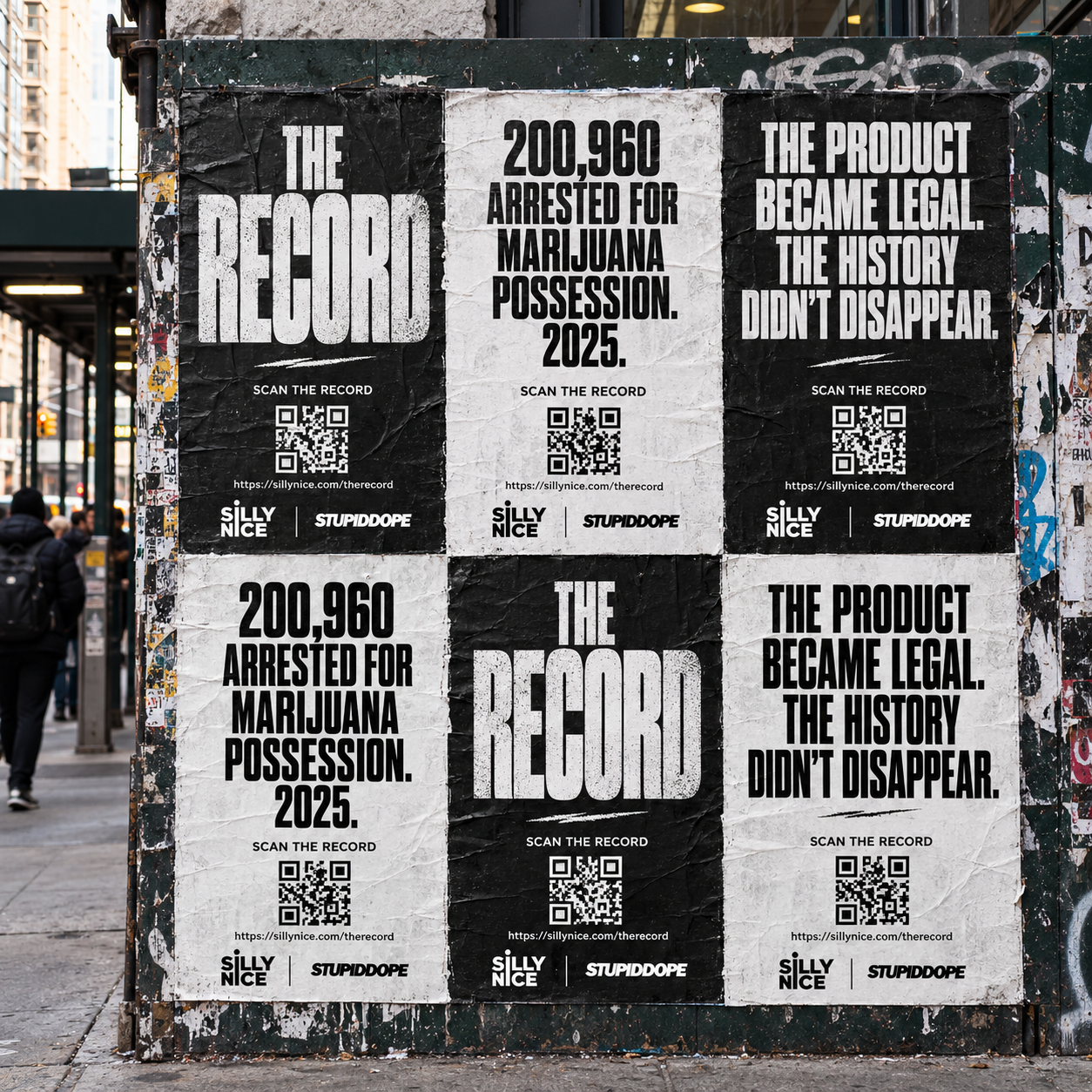
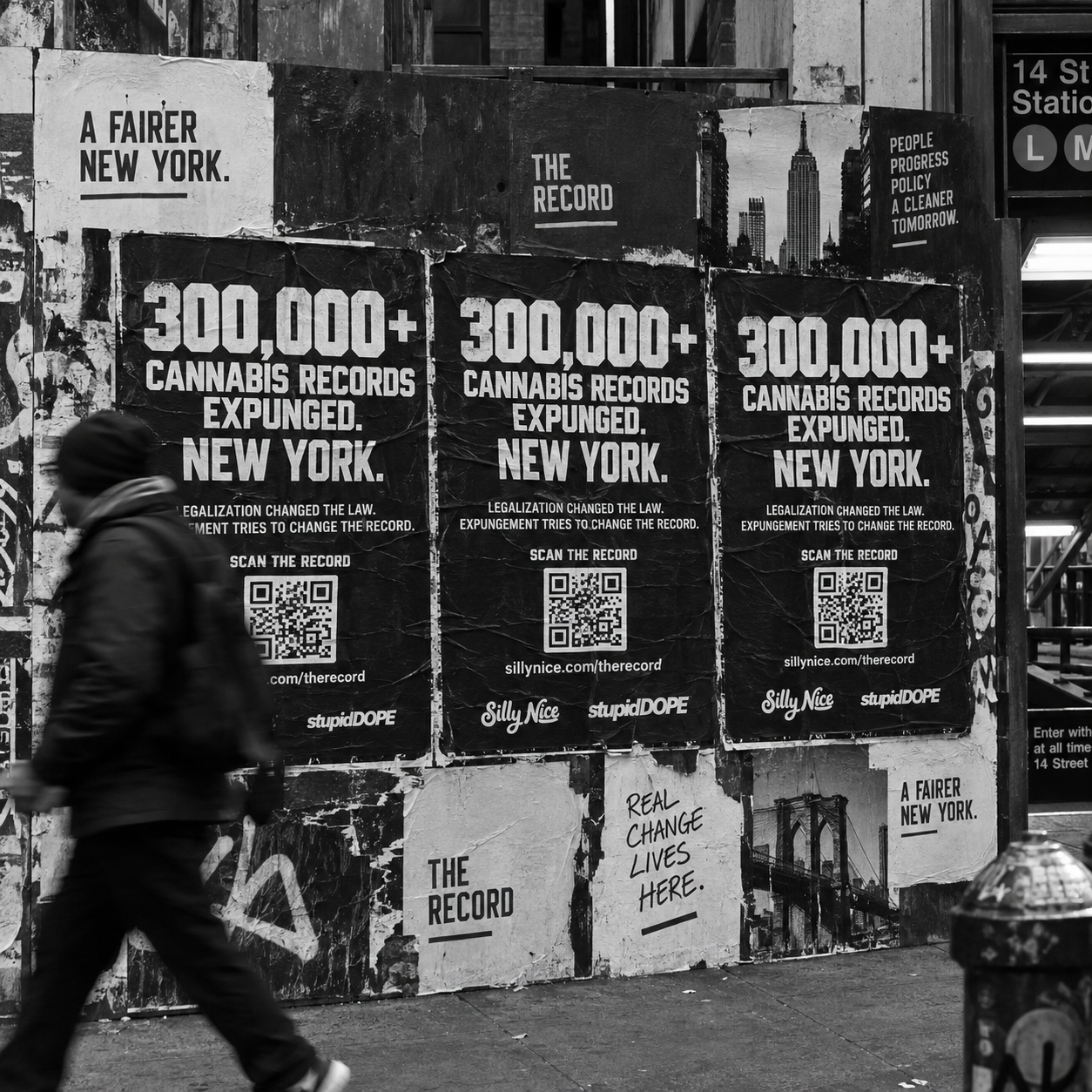
This powerful offline dynamic forms the foundation of THE RECORD, a cannabis justice and public policy editorial initiative co-founded by New York cannabis brand Silly Nice alongside stupidDOPE, an independent culture and lifestyle platform established in 2008.
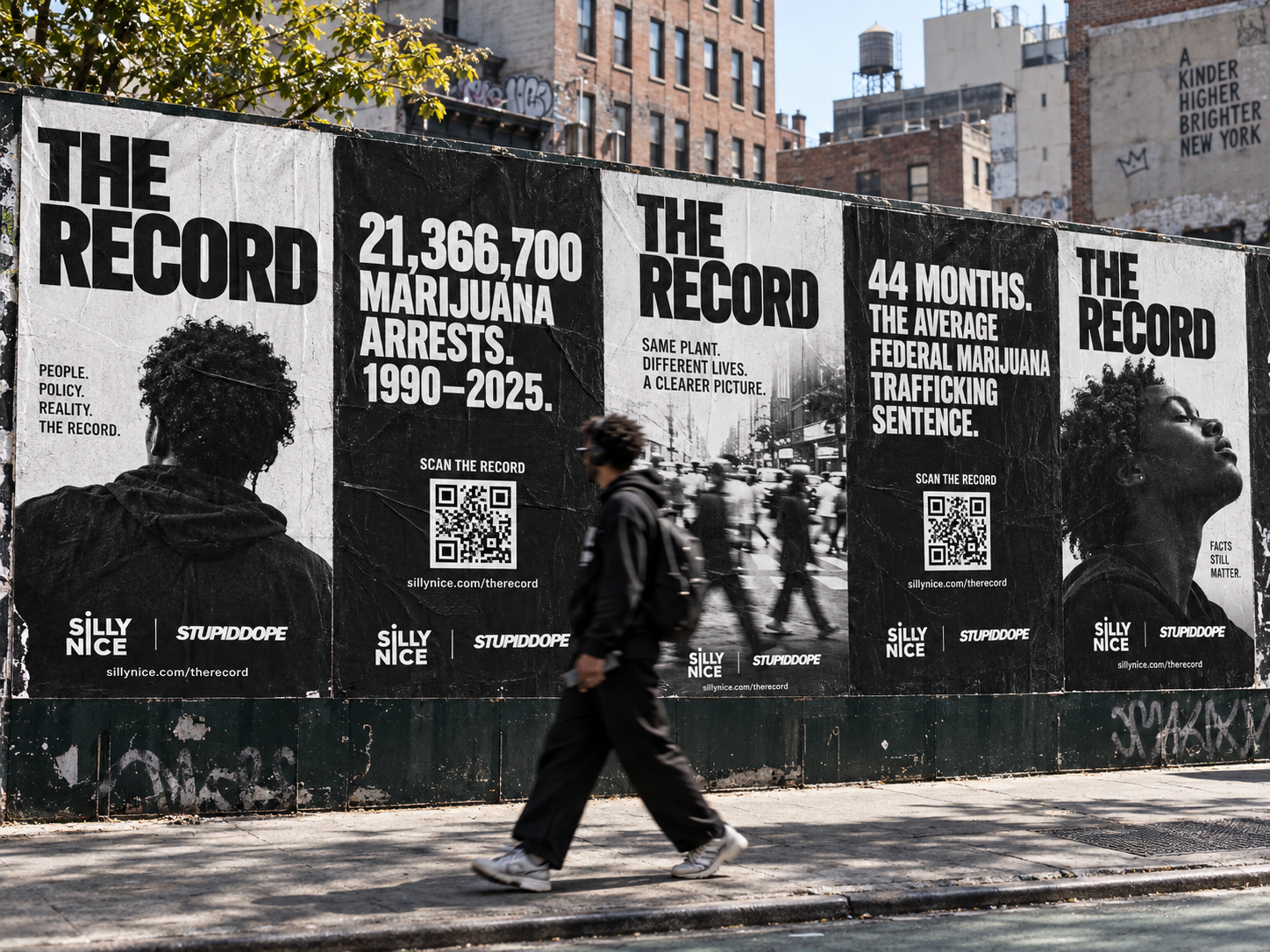
Rather than pouring advertising dollars into digital auctions that restrict cannabis and justice discussions, THE RECORD turns to the raw visual vocabulary of New York City: high-contrast, black-and-white wheatpaste street posters installed directly at neighborhood intersections where pedestrian traffic congregates.
Each poster displays rigorously sourced, institutional metrics on cannabis arrests, regional sentencing disparities, and expungement records—sourced from primary bodies such as the FBI Uniform Crime Reporting Program, the United States Sentencing Commission, and the New York State Office of Cannabis Management. Prominently integrated QR codes link pedestrians instantly from sidewalk discovery to THE RECORD's deep-dive digital archives.
Hyper-Local Cultural Resonance Over Algorithmic Proximity
By placing stark data in neighborhoods that were disproportionately impacted by prohibition-era enforcement, THE RECORD's street-level execution produces an impact that no geofenced mobile ad can replicate. The wheatpaste format acknowledges the visual history of New York street culture, establishing immediate authenticity and communal dialogue.
As documented in guerrilla and street marketing analyses, striking physical posters reward second looks and prompt spontaneous mobile photography, creating an organic multiplier effect where real-world street art transforms into viral social media documentation without spending a dollar on ad clicks.
The Playbook for Modern Urban Brand Visibility
For regional enterprises and civic campaigns seeking genuine visibility, the lessons of the New York sidewalk are unequivocal. Digital targeting provides scale, but street-level presence delivers credibility, durability, and true physical connection.
By anchoring a brand in the physical geography of the city, marketers bypass the friction of digital saturation. When executed with strong visual design, credible data, and a clear bridge to the digital ecosystem, street-level media proves that the most direct route to consumer trust isn't hidden in a smartphone screen—it is embedded on the pavement under our feet.
Topics