Introduction
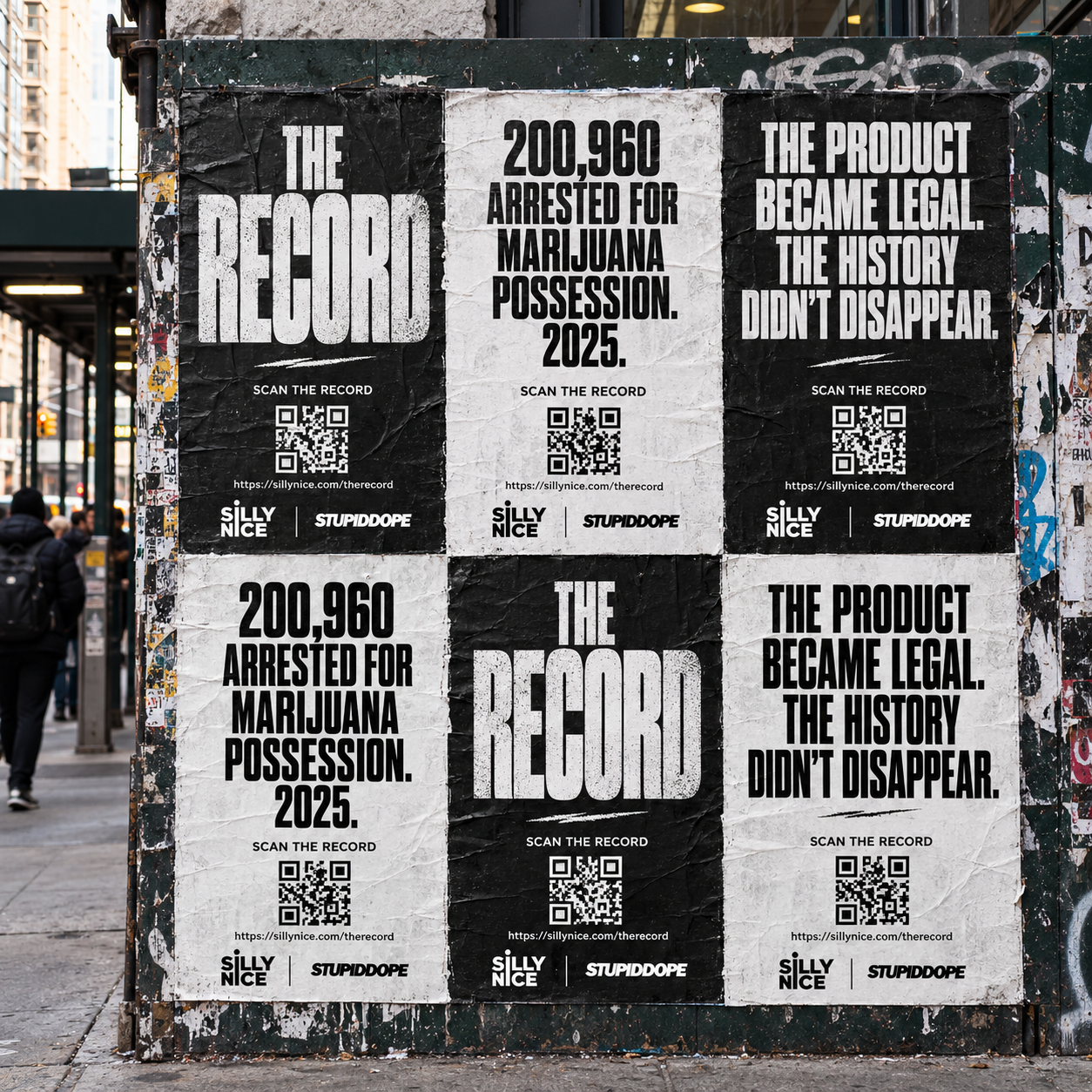
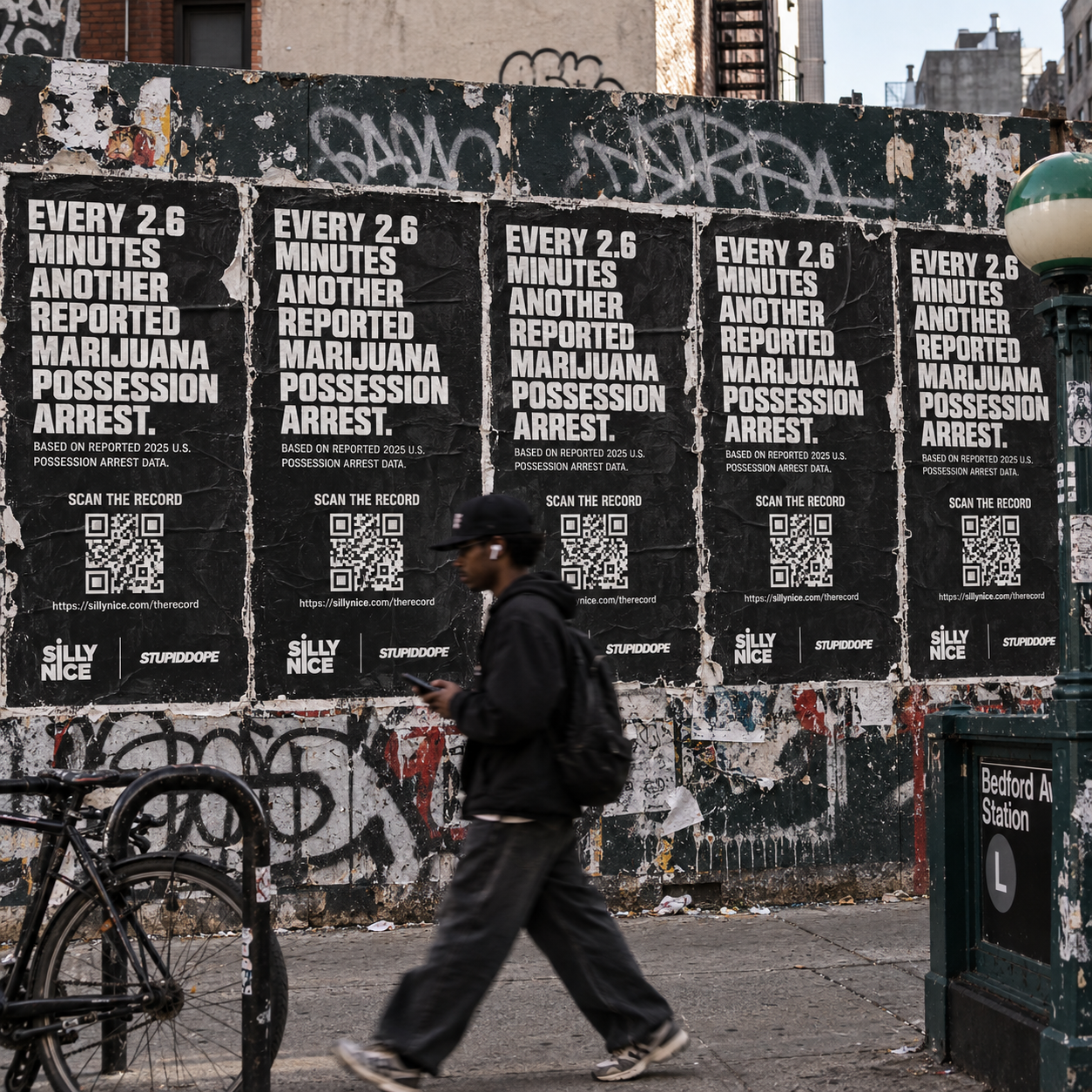
In an era defined by digital saturation, algorithmic filtering, and ubiquitous ad-blocking technology, the modern consumer has mastered the art of looking away. We skip, we scroll, and we mute. Yet, when confronted with a massive, wheatpasted poster on a city street corner, the human eye cannot simply swipe it away. This cognitive friction is the foundational premise of THE RECORD, a new cannabis justice editorial initiative published by Silly Nice and stupidDOPE. By leveraging the raw, unskippable power of physical street advertising, the campaign forces pedestrians to confront a staggering statistical reality: in the United States, there is one reported marijuana possession arrest every 2.6 minutes.
This per-minute rate is not a rhetorical device; it is a mathematical certainty derived from the 200,960 reported marijuana possession arrests in 2025. Calculated across the 525,600 minutes in a year, the math yields approximately 0.38 arrests per minute, or one every 2.6 minutes. When this figure is plastered across a construction hoarding in stark black and white, it strips away the sanitized narratives of the booming legal cannabis industry and replaces them with the cold, hard machinery of the criminal justice system. Physical advertising, in this context, ceases to be a marketing tool and becomes a mechanism for public accountability.
The initiative demands that we ask uncomfortable questions about the dichotomy of American drug policy. How can a nation that has birthed a multi-billion-dollar legal cannabis market simultaneously sustain an enforcement apparatus that continues to arrest hundreds of thousands of its citizens for the exact same plant? By placing these verified statistics in the physical path of daily commuters, THE RECORD ensures that the data cannot be algorithmically suppressed. It is a deliberate editorial strategy designed to bridge the gap between abstract policy debates and the tangible, ongoing reality of prohibition enforcement.
The Current Data
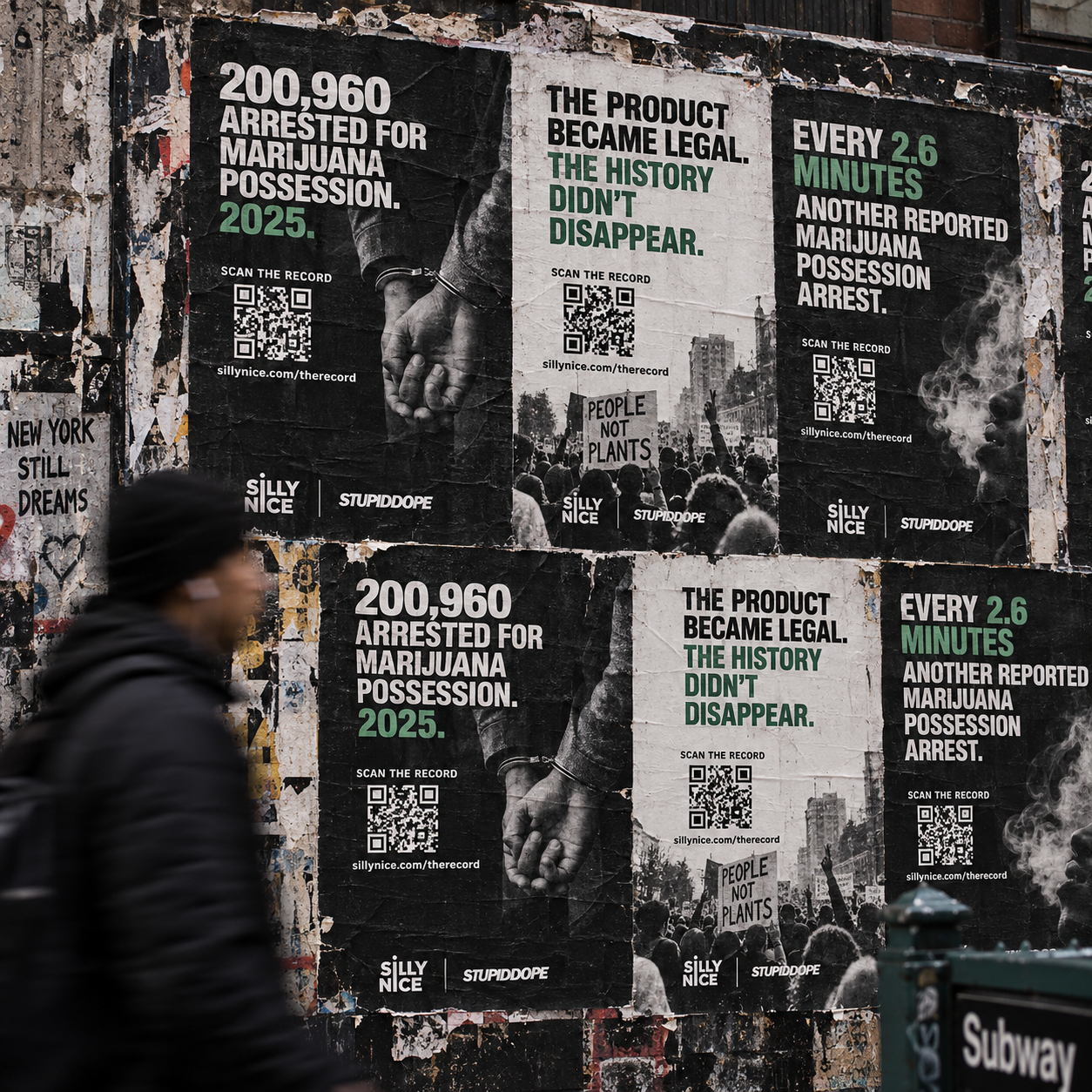
To understand the scale of the issue, one must examine the most recent verified statistics from the federal government. According to the 2025 Arrest Data published by the FBI Crime Data Explorer in September 2026, law enforcement agencies reported 200,960 marijuana possession arrests in 2025. When combined with the 17,192 marijuana sales and manufacturing arrests, the total reaches 218,152 marijuana-related arrests for the year. These figures are not estimates; they are the reported totals submitted by local, state, and federal agencies to the national database.
The sheer volume of these arrests reveals a persistent focus on cannabis within the broader context of drug enforcement. The FBI data indicates that approximately 23 percent of all drug-related arrests nationwide were for marijuana possession. This means that nearly one in four drug arrests in the United States is driven by the simple possession of a substance that is fully legal for adult use in nearly half the country. Furthermore, it is crucial to note that approximately 13 percent of law enforcement agencies did not submit complete data to the FBI in 2025, meaning the actual totals are likely even higher than the reported 218,152.
This data underscores a critical tension in American jurisprudence. While the cultural narrative suggests that the "war on weed" is winding down, the statistical reality proves that the enforcement machinery remains highly active. The reliance on government data, specifically the FBI's Uniform Crime Reporting (UCR) program, provides an unassailable baseline for this analysis. By utilizing these exact numbers, investigative journalism can pierce through the fog of anecdotal optimism and present a clear, empirical picture of the current state of cannabis prohibition.
Historical Context
The 2025 figures do not exist in a vacuum; they are the latest entries in a decades-long ledger of enforcement. A comprehensive compilation of FBI UCR data by NORML reveals a staggering 21,366,700 cumulative marijuana-related arrests from 1990 to 2025. This historical context is essential for understanding the generational impact of prohibition. The data shows a clear escalation and subsequent, albeit slow, deceleration of enforcement over the past three and a half decades.
Breaking down the numbers by decade illustrates the trajectory of the drug war. Between 1990 and 1999, there were 5,132,304 marijuana arrests. The following decade, from 2000 to 2009, represents the highest period on record, with 7,877,165 arrests. The peak year occurred in 2007, which saw an unprecedented 872,721 arrests. The period from 2010 to 2019 saw a slight decline to 6,921,146 arrests, reflecting the initial wave of state-level legalizations. Finally, the current decade, from 2020 to 2025, has recorded 1,436,085 arrests, showing a marked decline amid widespread state legalization, yet still representing a massive number of individuals processed through the justice system.
This historical data highlights the inertia of institutional policy. Even as public opinion shifted and state laws began to change, the momentum of the enforcement apparatus carried forward, resulting in millions of arrests. The cumulative total of over 21.3 million arrests is a testament to the vast resources expended on prohibition. According to a 2013 estimate by the ACLU—the most recent comprehensive estimate of its kind—enforcement of cannabis prohibition cost approximately $3.6 billion per year. While this figure predates widespread legalization and may not reflect current costs, it provides a window into the immense financial scale of the historical enforcement effort.
What the Numbers Mean
Interpreting this vast array of data requires careful attention to critical legal and statistical distinctions. First and foremost is the difference between arrests and convictions. The FBI data captures arrests—the initial point of contact with the criminal justice system. It does not indicate how many of those 218,152 individuals arrested in 2025 were ultimately convicted. An arrest alone, however, can result in significant trauma, legal expenses, and temporary loss of liberty, regardless of the final judicial outcome.
Similarly, one must distinguish between convictions and incarceration. Many individuals convicted of state-level possession offenses may receive probation or fines rather than jail time. However, this introduces another layer of systemic risk. According to the REFORM Alliance, there are nearly 3.7 million people on probation or parole in the United States in 2025. The supervision system is the largest feeder of people into prison, often for technical violations—such as missing a meeting or being unable to pay fees—rather than new crimes. Thus, a non-incarcerative sentence for marijuana possession can easily become a trapdoor to prison.
Furthermore, the data requires a clear delineation between possession and trafficking, as well as between federal and state cases. The overwhelming majority of the 218,152 arrests in 2025 were state-level possession cases (200,960). Federal cases, by contrast, are far fewer in number but carry significantly harsher penalties and are almost exclusively focused on trafficking rather than simple possession. Finally, it is vital to recognize the difference between government data (the raw numbers reported by agencies) and compilations or estimates (analyses that attempt to account for missing data). The figures used here are the reported totals, meaning the true scale of enforcement is likely broader.
The Human Impact
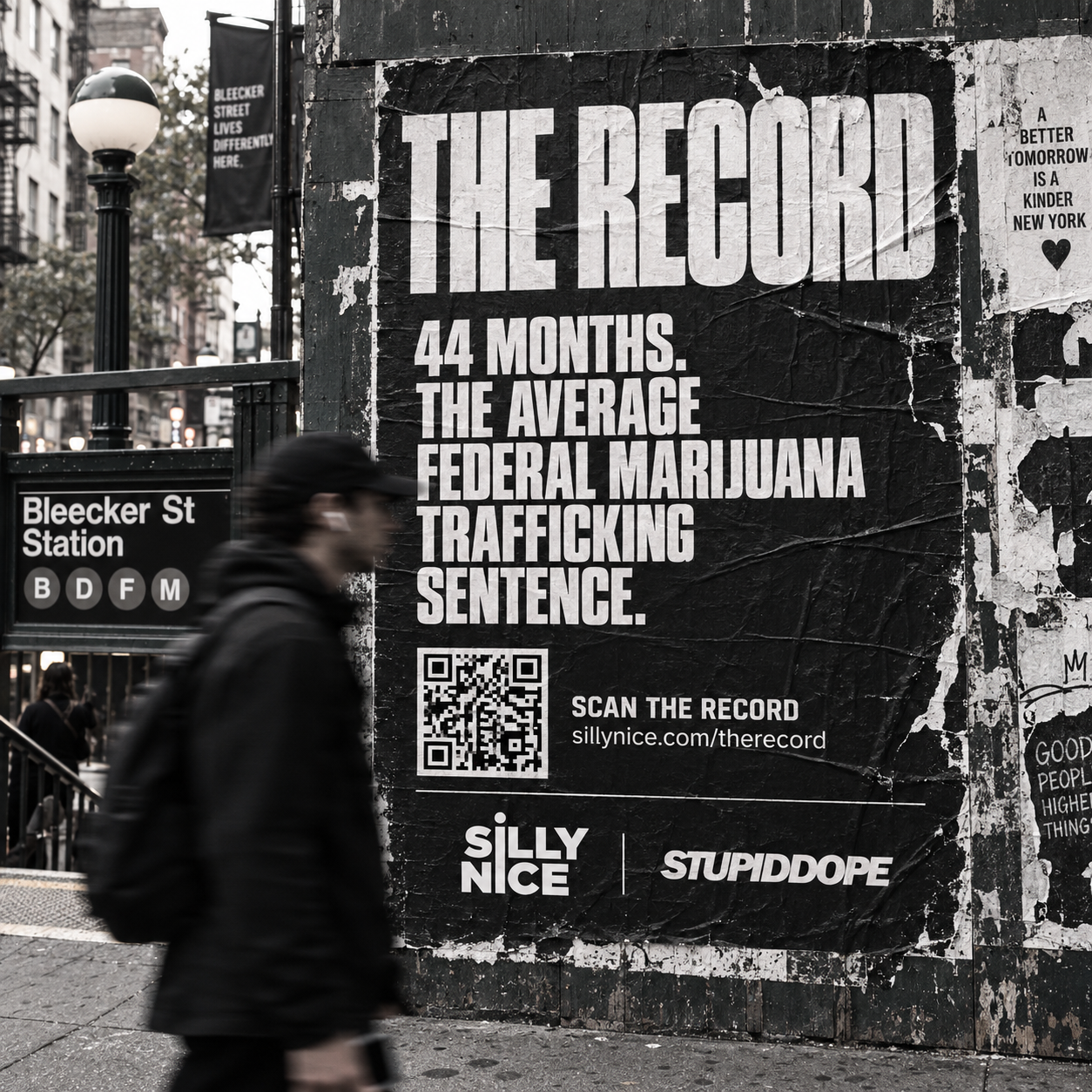
Behind every statistic is a tangible human consequence. The federal sentencing data provides a stark look at the most severe end of the enforcement spectrum. According to the U.S. Sentencing Commission, 389 individuals were sentenced for marijuana offenses under USSG Chapter Two, Part D in FY2025. Of those individuals, a staggering 85 percent received prison sentences. The average federal marijuana trafficking sentence in FY2025 was 44 months. This means that while state-level possession arrests often result in misdemeanors, federal involvement typically guarantees years of incarceration.
The demographic breakdown of these federal sentences reveals profound racial disparities that cannot be ignored. According to the USSC, the individuals sentenced federally in FY2025 were 88 percent men, 42 percent Black, 30 percent Hispanic, 15 percent White, and 12 percent other. When cross-referenced with 2023 U.S. Census Bureau data, the disproportionality becomes glaring. Black Americans make up approximately 13.6 percent of the U.S. population but account for 42 percent of federal marijuana sentences, making them 3.1 times over-represented. Hispanic Americans, at 19.5 percent of the population, account for 30 percent of sentences (1.5 times over-represented). Conversely, White Americans, who comprise 58.4 percent of the population, account for only 15 percent of sentences (0.3 times under-represented).
These disparities are compounded by the fact that 80 percent of those sentenced federally were U.S. citizens, and 64 percent had little or no prior criminal history. The human impact extends beyond the individuals incarcerated; it fractures families and destabilizes communities. Organizations like the Last Prisoner Project (LPP) work tirelessly to mitigate this damage. In 2025, LPP reported saving over 400 years of potential prison time through clemency and release programs, clearing over 250,000 offenses, and distributing $3.8 million in direct support to impacted individuals. Yet, these efforts, while heroic, are a response to a systemic failure that continues to generate new victims daily.
What Has Changed
Despite the grim statistics, the landscape of cannabis policy has undergone a seismic shift over the past decade. As of March 2026, 24 states, along with the District of Columbia, Guam, and the Northern Mariana Islands, have legalized recreational cannabis. Furthermore, 40 states, D.C., Puerto Rico, Guam, and the U.S. Virgin Islands have enacted comprehensive medical cannabis laws. This wave of legalization, which began with Colorado and Washington in 2012, has had a profound and measurable impact on arrest rates in those jurisdictions.
The 2026 Cannabis Arrest Report by the Marijuana Policy Project (MPP) provides definitive proof that legalization works as a criminal justice reform measure. According to the report, legalization states made 219,456 fewer arrests in 2025 than the year before each legalized. The average drop in cannabis arrest rates after legalization is an astounding 85.53 percent. Specifically, possession arrests fell by 84.61 percent, and sales arrests fell by 80.39 percent. The data is unequivocal: cannabis arrests dropped in every single state after legalization, and the 20 states with the lowest cannabis arrest rates are all legalization states.
Beyond reducing new arrests, states are also addressing the historical damage through record clearance. In New York, which legalized via the Marijuana Regulation and Taxation Act (MRTA) in 2021, the Office of Cannabis Management and the state courts have identified over 400,000 cannabis-related records for expungement. It is critical to understand the legal distinction here: under NY law (CPL 1.20(45)), expungement means the arrest, court case, and conviction are treated as if they never happened, and they do not appear on background checks. This is legally distinct from sealing, where records still exist but access is restricted, or pardons and clemency, which forgive the offense but do not necessarily erase the record.
What Remains Unresolved
While legalization states have seen dramatic improvements, a stark geographic divide remains. The MPP report notes that prohibition states made eight times more cannabis arrests than legalization states in 2025 (186,581 versus 22,357). A NORML compilation of the 2025 data highlights the intense concentration of enforcement in specific regions. Ten states accounted for approximately 60 percent of all marijuana arrests: Texas, North Carolina, Wisconsin, Georgia, Tennessee, Pennsylvania, South Carolina, Indiana, Louisiana, and Alabama. Texas alone accounted for roughly 14 percent of the national total, with over 29,000 marijuana-related arrests—equating to one arrest every 18 minutes in that state alone.
The disparity between legal and prohibition states is jarring. Five states reported over 11,000 possession arrests each: Texas, Georgia (11,238), North Carolina (11,830), Tennessee (11,194), and Wisconsin (11,470). In contrast, five legal states reported fewer than 100 arrests: Alaska (92), Maine (96), Montana (35), Rhode Island (99), and Vermont (16). Even more concerning, in six states—Louisiana, Idaho, Iowa, Wisconsin, Nebraska, and Kansas—over 50 percent of all drug arrests were for marijuana. Three states—Idaho, Kansas, and American Samoa—still have no medical cannabis access whatsoever.
Looming over this patchwork of state laws is the unresolved issue of federal prohibition. According to the Congressional Research Service (updated March 10, 2026), cannabis remains a Schedule I controlled substance under the federal Controlled Substances Act (21 U.S.C. §§801 et seq.). Schedule I classification dictates that the substance has a high potential for abuse, no currently accepted medical use, and a lack of accepted safety for use under medical supervision. This policy gap between federal classification and state legalization creates ongoing legal jeopardy, banking hurdles for legal businesses, and the continued justification for federal trafficking prosecutions, primarily concentrated in border districts like the Western District of Texas (43 cases) and the Southern District of Texas (38 cases).
Conclusion
The data is irrefutable. With 200,960 reported marijuana possession arrests in 2025, the machinery of prohibition continues to operate at a staggering pace, generating one arrest every 2.6 minutes. While state-level legalizations have proven effective—driving an 85.53 percent average drop in arrest rates and facilitating the expungement of over 400,000 records in New York alone—the geographic and racial disparities of enforcement remain a profound national failure. The federal government's continued classification of cannabis as a Schedule I substance ensures that the conflict between state and federal law will persist, leaving hundreds of thousands of citizens vulnerable to a justice system that disproportionately targets minority communities.
This is why physical advertising remains the last unskippable medium. By taking these verified statistics out of policy white papers and pasting them onto the physical architecture of our cities, THE RECORD forces a public reckoning. It demands that we look at the 21,366,700 cumulative arrests since 1990 not as abstract history, but as a living ledger of injustice. As the legal industry continues to generate billions, we cannot afford to look away from the human cost that paved its way. To explore the full scope of this data and the ongoing campaign for cannabis justice, visit THE RECORD at https://sillynice.com/therecord.
Topics