The Architectural Contradiction of Legalization
When the first adult-use dispensary transaction in New York State took place in lower Manhattan in late December 2022, state officials heralded the moment as the dawn of the most progressive cannabis marketplace in the nation. The goal was unambiguous: engineer an economy where the communities most damaged by the War on Drugs would hold first-mover advantage, capturing capital, licensing priority, and commercial autonomy. Yet walk the avenues of New York City or study the ledgers across upstate counties today, and the market reveals an intricate, high-stakes battle between regulatory theory and institutional history.
By 2025, New York’s Office of Cannabis Management (OCM) reported that annual legal cannabis sales climbed to approximately $1.69 billion across a network of more than 450 licensed adult-use dispensaries. What appears on paper as explosive commercial momentum is, in practice, a commercial structure operating directly atop the scar tissue of a century-long punitive apparatus. The market did not emerge in a vacuum; it inherited a century of policing tactics, selective prosecution, and municipal distrust that cannot be dismantled solely through storefront ribbon-cuttings.
From Rockefeller to Stop-and-Frisk: A Century of State Sanction
Cannabis prohibition in New York was codified in 1927 when the state legislature removed medical allowances and imposed a blanket ban on the plant, long before the federal Marihuana Tax Act of 1937 took effect. For nearly fifty years, enforcement was sporadic and largely invisible in mainstream public discourse. That dynamic ended violently in 1973 with the enactment of the Rockefeller Drug Laws, which established stringent mandatory minimum sentences for possession and sale, triggering a catastrophic escalation in state incarceration rates.
While New York nominally passed the Marijuana Reform Act of 1977 to decriminalize private possession of small quantities, lawmakers left a critical loophole that defined public policy for the next forty years: possession 'in public view' remained a class B misdemeanor. Decades later, as the New York City Police Department operationalized aggressive 'stop-and-frisk' tactics during the 1990s and 2000s, officers routinely ordered stopped individuals to empty their pockets. When a baggie of cannabis was pulled into open air, it technically met the statutory threshold for criminal possession in public view, leading directly to an arrest and fingerprinting.
The demographic burden of that loophole was overwhelmingly borne by Black and Latino New Yorkers. Data compiled across the era showed that despite comparable or lower rates of consumption compared to white residents, non-white individuals comprised over 80 percent of all marijuana arrests in the five boroughs. Between the mid-1990s and late 2010s, hundreds of thousands of lives were derailed by minor cannabis infractions that closed doors to federal student aid, public housing, professional licensing, and parental custody.
The Marihuana Regulation and Taxation Act: Codifying Restorative Justice
Signed into law in March 2021, the Marihuana Regulation and Taxation Act (MRTA) dismantled Article 221 of the New York State Penal Law, replacing it with Article 222 and establishing the OCM under the Cannabis Control Board. Unlike adult-use frameworks in early-adopter states like Colorado or Washington, which favored capitalized corporate operators, New York’s legislation embedded statutory equity targets into its architecture: 50 percent of all commercial adult-use licenses were designated for Social and Economic Equity (SEE) applicants, including minority- and women-owned businesses, distressed farmers, service-disabled veterans, and individuals from communities disproportionately impacted by enforcement.
Equally critical was the statutory framework for state tax revenue allocation. Under the MRTA, after administrative costs are met, 40 percent of adult-use cannabis tax revenues are mandated for community reinvestment through the State Community Grants Fund, another 40 percent goes directly to the State Lottery Fund for education, and the remaining 20 percent funds drug treatment, harm reduction, and public health campaigns. The legislation codified cannabis not as an ordinary vice commodity, but as a mechanism for institutional wealth redistribution.
The Reality of Expungement: Vacating Hundreds of Thousands of Records
A foundational pillar of the MRTA was automatic expungement for past marijuana offenses. Under New York Criminal Procedure Law, convictions under former Penal Law Article 221—specifically possession up to 16 ounces or sale up to 25 grams—were classified as eligible to be vacated, dismissed, and declared a legal nullity without requiring individuals to hire attorneys or pay court filing fees.
To date, more than 300,000 marijuana records have been suppressed and processed for automatic expungement across New York State. By law, these convictions are sealed from criminal history database searches administered by the Division of Criminal Justice Services and the courts, allowing individuals to legally answer that they have never been convicted of those offenses when completing employment or housing applications. Yet legal aid organizations emphasize that expungement remains an imperfect eraser: institutional memory lingers, background-check brokers often maintain un-updated private cache records, and federal immigration consequences can still trigger severe scrutiny.
A Market Caught Between Enforcement and Enterprise
The rollout of New York's legal market was neither swift nor frictionless. Initial licensing programs prioritized justice-involved individuals under Conditional Adult-Use Retail Dispensary (CAURD) permits, but legal injunctions, capital constraints, real estate hurdles, and administrative bottlenecks delayed openings throughout 2023. During this regulatory void, an estimated 2,000 to 3,000 illicit bodegas, smoke shops, and unlicensed retailers proliferated across New York City and surrounding boroughs, creating severe headwinds for newly licensed dispensaries bearing high compliance, testing, and tax burdens.
The state countered with aggressive policy pivots in the Fiscal Year 2025 budget, expanding statutory authority for local governments, city corporations, and the OCM to padlock unlicensed storefronts, seize untaxed products, and impose steep financial penalties. As enforcement stabilized the street-level retail environment, the legal marketplace broadened rapidly. By 2026, analysts projected that New York was on pace to surpass $4 billion in annual adult-use revenue as hundreds of additional retail, delivery, and microbusiness licenses achieved full commercial operation.
Why Cultural Authenticity Demands Confronting History
As the commercial engine normalizes across the state, a profound cultural tension has taken root. When cannabis was prohibited, product value was dictated by underground strain mythologies—Sour Diesel, Haze, Northern Lights. In the regulated landscape, brand identity, lab-tested purity, and narrative authority have become the primary currency. Consumers in Brooklyn, Rochester, and Syracuse increasingly evaluate not merely the percentage of cannabinoids on a Certificate of Analysis, but who stands behind the supply chain.
This landscape is precisely where independent New York brands like Silly Nice operate. Founded by a diverse team that reflects veteran, Black, and LGBTQ representation, the brand carved out significant retail traction across the state not by running from the complexity of prohibition, but by building within New York's licensed farm-and-processor network. Known for artisanal, high-potency formats such as handcrafted Bubble Hash, Frosted Hash Balls, and Diamond Powder, Silly Nice pairs technical craft with a public commitment to market integrity.
This commitment to historical accountability underpins THE RECORD, the editorial justice initiative launched collaboratively by Silly Nice and stupidDOPE, the culture publication documenting street-level arts, music, and civil rights since 2008. Recognizing that the corporate sanitization of cannabis threatens to erase the sacrifices of those targeted by prohibition, THE RECORD was conceived to bridge public knowledge gaps through rigorous, data-driven journalism and high-visibility physical media.
From Public Walls to the Public Conscience
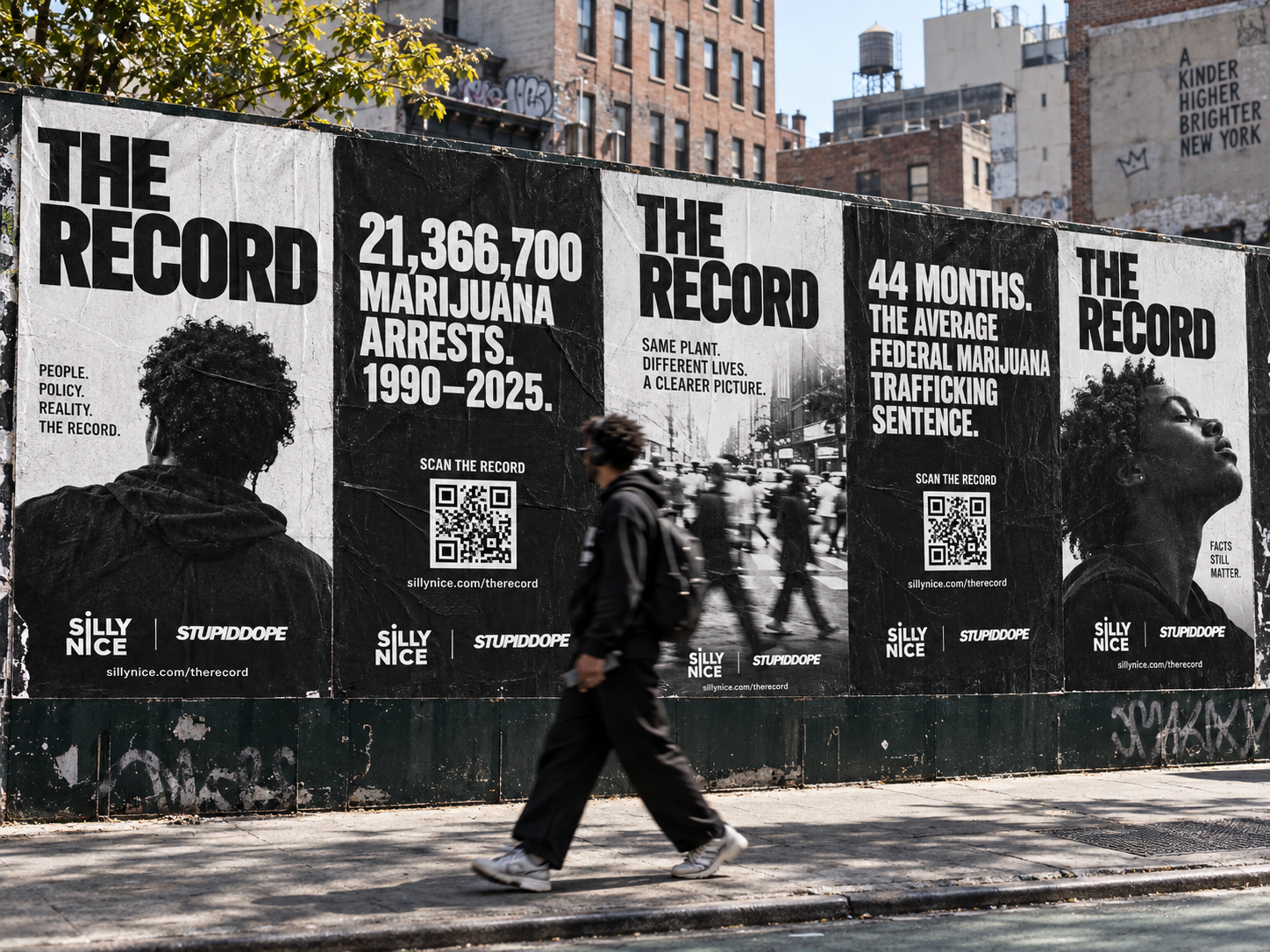
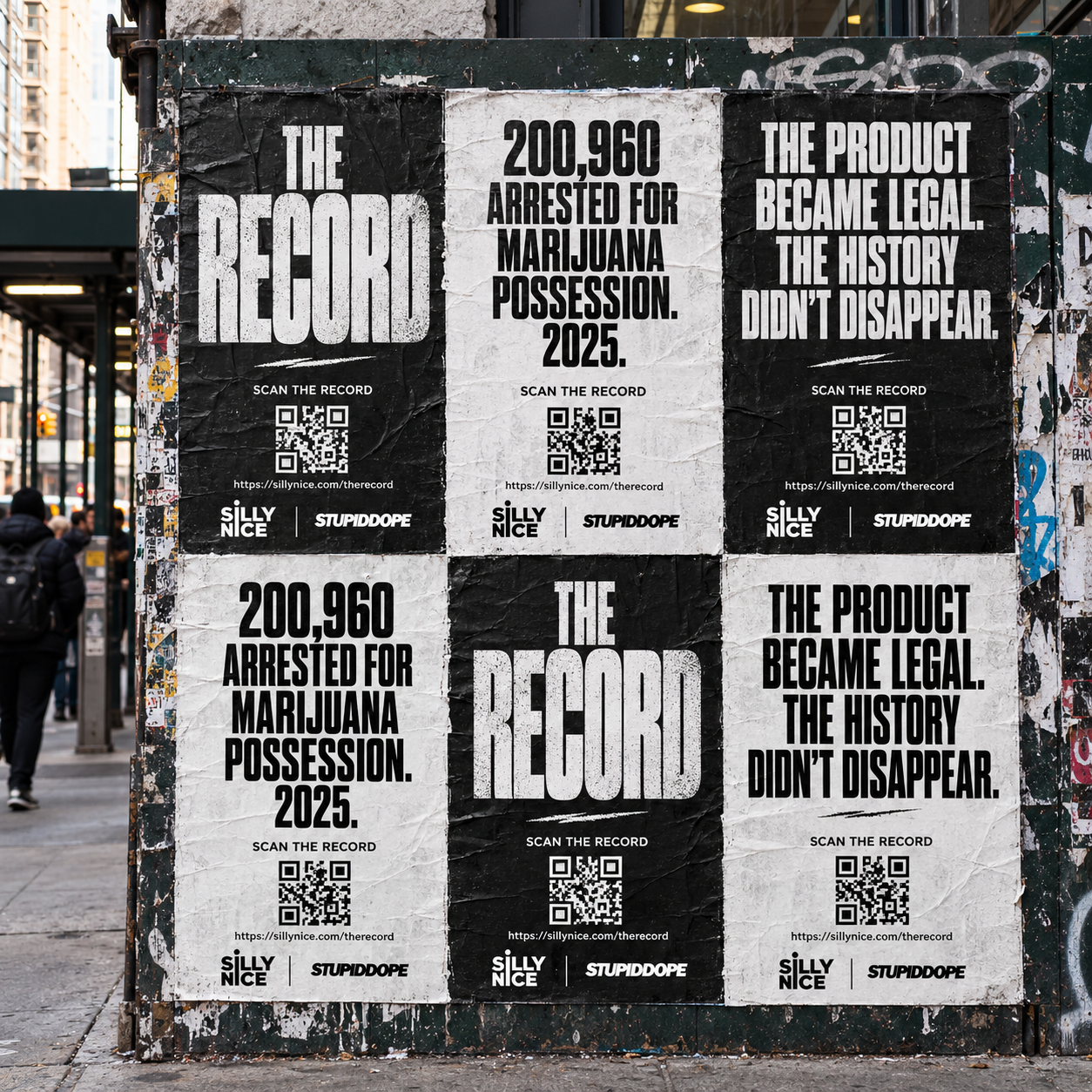
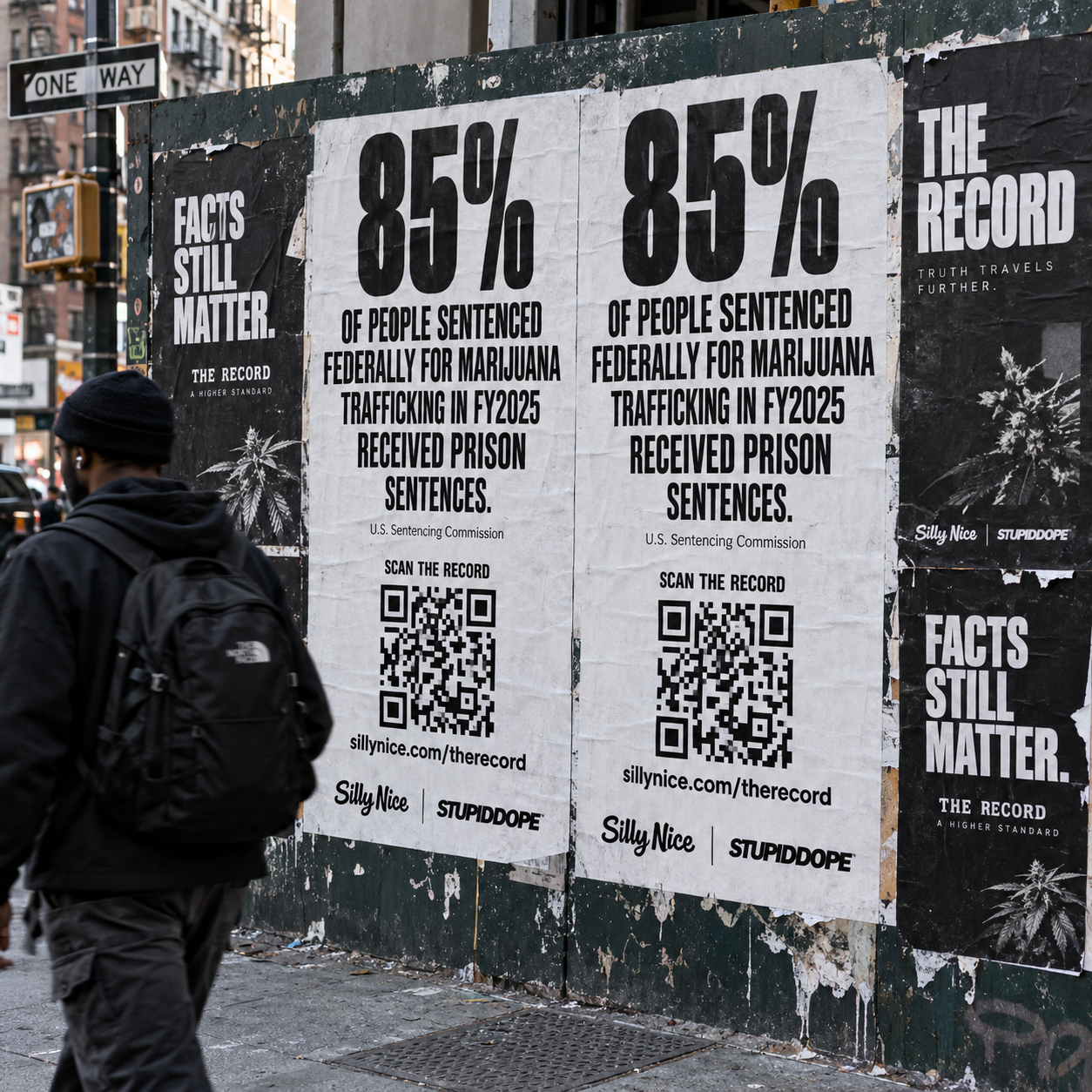
Central to the platform's execution is an upcoming New York City street poster campaign, utilizing raw, black-and-white wheatpaste broadsides placed in high-density urban corridors throughout Manhattan, Brooklyn, and Queens. Each poster isolates a single verifiable metric—arrest counts by neighborhood, federal sentencing disparities, or expungement backlogs sourced directly from the FBI, U.S. Sentencing Commission, and New York State Court records—coupled with a direct QR code routing pedestrians to comprehensive reporting.
The intervention is a deliberate reclaiming of physical public space. The same sidewalks where young men were once systematically stopped, searched, and hand-cuffed for a burned roach now host commercial advertisements for legal delivery dispensaries. Wheatpasting verifiable prohibition statistics directly across those corridors forces the city to reckon with its immediate past, resisting the collective amnesia that frequently accompanies commercial deregulation.
The Architecture Ahead
New York is attempting something without precedent in global drug policy reform: building a multi-billion-dollar legal supply chain that serves as direct restitution for state-sponsored prohibition. The experiment remains fraught with municipal resistance, tax friction, and capital volatility. Townships across Long Island and Upstate regions still maintain retail opt-outs, and independent operators continue to navigate an intense regulatory environment with thin operating margins.
Yet the trajectory of the market will ultimately be decided not just by quarterly tax receipts or retail door counts, but by whether the foundational promises of the MRTA survive commercial consolidation. Expunging 300,000 court files cleared legal dockets; the ongoing challenge is ensuring that the people who lived through that enforcement are not locked out of the prosperity they cleared the way for. Through transparent data, honest reporting, and continuous institutional scrutiny, the record of how New York arrived here must remain indelible.
Topics