The Anatomy of a Number: Why Statistics Conceal What They Measure
In the archives of criminal justice research, raw numbers are routinely presented as immutable facts. We cite aggregate metrics with institutional reverence: over 25 million reported cannabis arrests across decades of federal tracking, hundreds of thousands of annual booking entries, or state-specific totals like 200,960 individual enforcement events. These figures are cited on floor speeches in Congress, integrated into policy white papers, and leveraged in civil rights campaigns. Yet every statistician and investigative reporter operating in this space encounters an unsettling truth: an aggregate figure can be entirely accurate while remaining thoroughly insufficient to convey the lived reality of human enforcement.
Data in criminal justice is not a passive artifact uncovered in the wild; it is an administrative by-product. As legal scholar Amy F. Kimpel notes in her landmark analysis of criminal expungement data, the public record captures only a fraction of enforcement activities due to voluntary, non-standardized participation in the FBI Uniform Crime Reporting (UCR) Program.
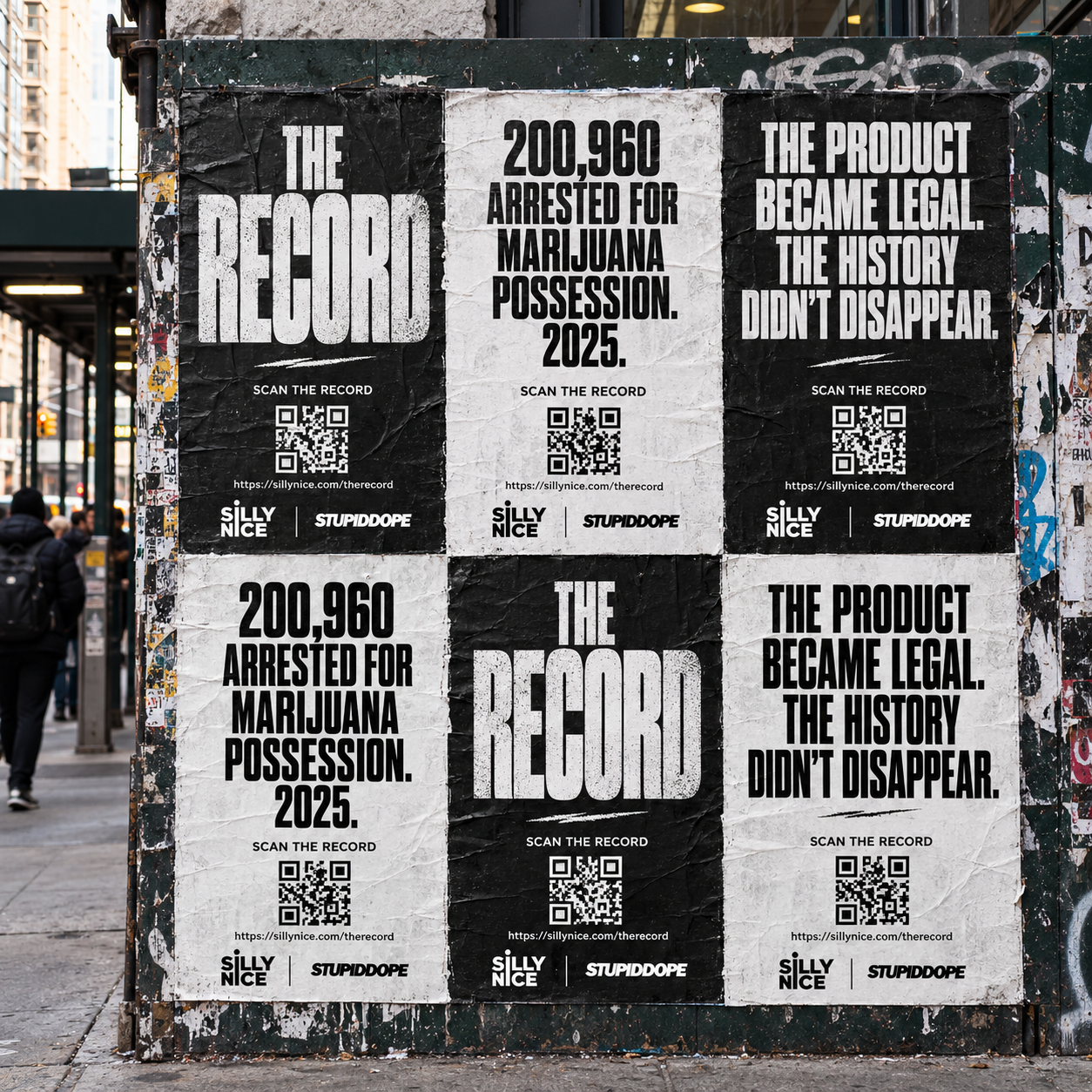
When an agency reports 200,960 drug arrests, it reports an institutional transaction rather than the texture of state intrusion. It records the filing of paperwork, the creation of an arrest sheet, and the assignment of a case docket. It does not measure the night spent on a precinct bench, the job application revoked upon a background check notification, or the cumulative trauma visited upon specific zip codes. The dilemma of the record keeper is that by converting systemic trauma into clean integers, we often strip the metric of the very human consequence it was collected to demonstrate.
The Gaps in the Ledger: Primary Sources and Missing Variables
To report on cannabis justice with genuine intellectual honesty requires interrogating the architecture of official repositories. Modern investigative initiatives like THE RECORD—an educational project spearheaded by New York craft cannabis brand Silly Nice and independent cultural chronicle stupidDOPE—ground their public-facing reporting entirely in primary government documentation, including repositories from the Federal Bureau of Investigation, the U.S. Sentencing Commission, and state regulators such as the New York State Office of Cannabis Management.
Yet relying on primary sources demands equal transparency regarding their structural limitations. For decades, the FBI’s historical arrest tables relied on voluntary reporting from local law enforcement agencies across the United States. Many municipal departments filed partial records; others skipped submission cycles entirely, masking large swaths of regional enforcement from national tallies.
National data projects such as the Criminal Justice Administrative Records System (CJARS), managed through a partnership between the University of Michigan and the U.S. Census Bureau, have demonstrated that traditional justice records suffer from profound fragmentation between police contact, prosecutorial charging, and final court disposition.
This fragmentation produces an epistemic vacuum: when records fail to follow an individual across the legal continuum, arrests that never produced a formal conviction remain etched in commercial background databases, silently constraining housing access and employment long after state charges are dismissed.
Context Over Sensationalism: The Ethics of Criminal Justice Reporting
In the race for algorithmic attention, media organizations frequently reduce criminal justice metrics to sensationalized headlines designed to provoke outrage or passivity. When presented without demographic, geographic, and socioeconomic context, raw arrest metrics can paradoxically normalize systemic inequities or give a false impression of universal, uniform policing.
Consider the reality of cannabis possession enforcement in the decade leading up to state-level reforms. Detailed nationwide evaluations conducted by the American Civil Liberties Union revealed that despite federal public health surveys demonstrating identical rates of consumption between Black and white populations, a Black person was, on average, 3.64 times more likely to be arrested for marijuana possession.
In select metropolitan jurisdictions, those enforcement ratios expanded dramatically. Historical analyses of New York City enforcement patterns published by The New York Times documented boroughs where Black residents were arrested at up to 15 times the rate of white counterparts for lower-level possession offenses, concentrated in heavily surveilled transit hubs and public housing corridors.
When journalists report an overall metropolitan arrest count without this demographic layer, they do not simply omit details; they actively mislead the public. The number without the disparity suggests an equal-opportunity enforcement regime that never existed. Contextualizing data is not an editorial overlay—it is an ethical necessity required to make the statistic reflect empirical truth.
The Expungement Paradox: When Erasing the Record Erases the Evidence
As legal reform advances across individual states, record keepers face a modern epistemological puzzle: the cannabis criminal records expungement paradox. Decriminalization and legalization statutes often rightfully mandate the automatic sealing or expungement of past convictions, restoring rights to hundreds of thousands of disenfranchised citizens.
Yet when state courts expunge or physically purge arrest and conviction ledgers, they frequently delete the longitudinal empirical evidence required by social scientists, legal scholars, and equity advocates to document the historical impact of the War on Drugs. In states implementing blanket statutory sealing, tracking whether prosecutorial challenges disproportionately disqualify low-income defendants from relief becomes increasingly opaque.
Legal experts emphasize that remedial justice programs must adopt dual-track information systems: sealing individual identities to shield individuals from societal stigma, while preserving anonymized geographic and demographic datasets. Without this careful preservation, the state risks erasing the paper trail of its own enforcement patterns under the guise of bureaucratic clean-slating.
From Public Square to Primary Source: THE RECORD’s Public Pedagogy
It is precisely this tension between statistical abstraction and immediate community reality that THE RECORD confronts. Initiated by Silly Nice, a Harlem-rooted cannabis business, alongside long-standing digital publication stupidDOPE, the project bypasses academic gatekeeping and corporate greenwashing through deliberate, accessible public intervention.
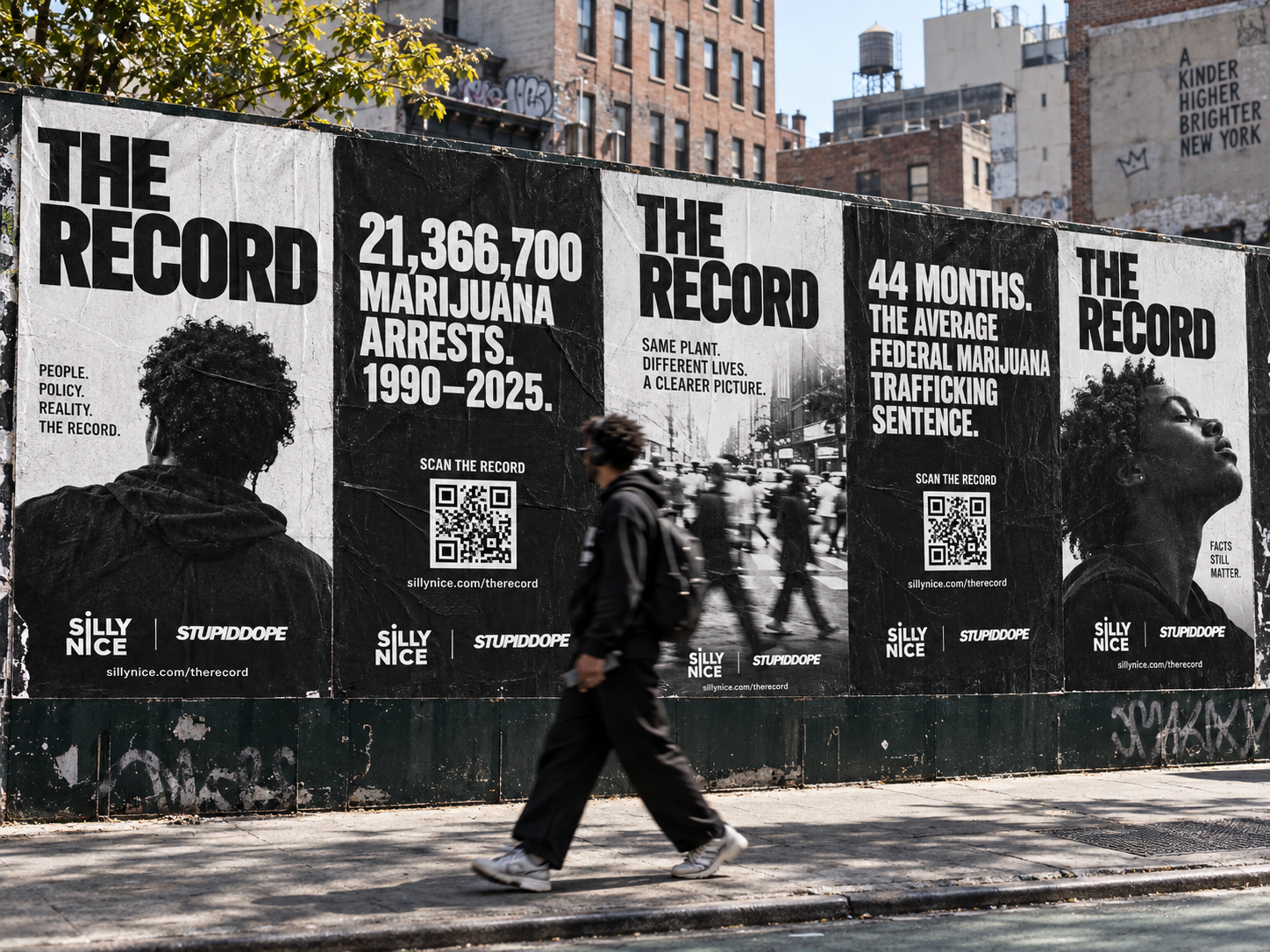
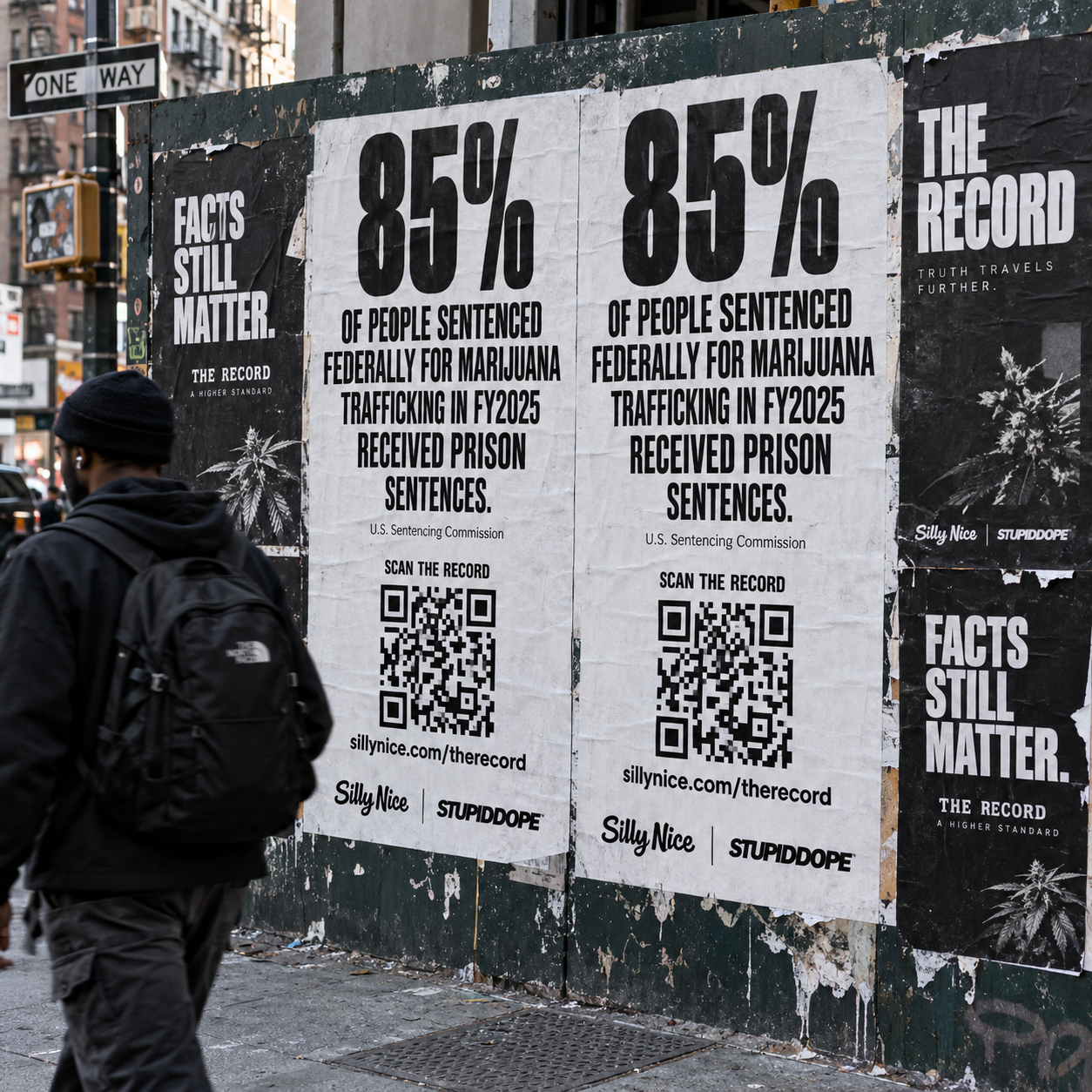
The initiative’s planned New York City campaign places minimalist black-and-white wheatpaste posters across the municipal landscape. Stripped of sensational corporate taglines, each poster displays austere, verified figures alongside an unvarnished QR code. Scanning that code directs passersby directly to primary source documentation, official court records, and government agency summaries.
This method bridges what data visualization researchers and human rights advocates identify as the central hurdle of public accountability: presenting complex institutional records in a format that meets ordinary citizens where they live, while maintaining verifiable evidentiary standards.
By placing stark data in public spaces where over-policing historically unfolded, THE RECORD transforms the urban street into an open reading room. The pedestrian does not view an artistic metaphor for prohibition; they engage directly with the exact statistical receipts compiled by law enforcement agencies over five decades.
The Responsibility of Truth-Telling in an Era of Narrative Drift
As the regulated cannabis industry matures, the political narrative surrounding the plant risks severe revisionism. Commercial marketing campaigns frequently celebrate state-licensed products while quietly severing the marketplace from the carceral machinery that paved its way. In this commercial transition, numbers can easily become hollow promotional slogans rather than instruments of accountability.
Ethical journalism in the justice sector requires a permanent commitment to evidentiary rigor. Every metric published must be traceable to its origin point. When THE RECORD cites an arrest volume, an expungement backlog, or a court disparity, it does not do so to craft sensational hyperbole, but to ensure that society’s official historical record remains tethered to verifiable truth.
The record keeper’s dilemma is ultimately a call to editorial discipline. The numbers are never the full story, but they are the necessary foundation from which systemic memory is built. By refusing to detach statistics from their social context, and by offering every citizen direct access to the underlying records, honest journalism ensures that the human costs of prohibition cannot be glossed over, distorted, or erased.
Topics