The Realities of Physical Space in a Digital Media Landscape
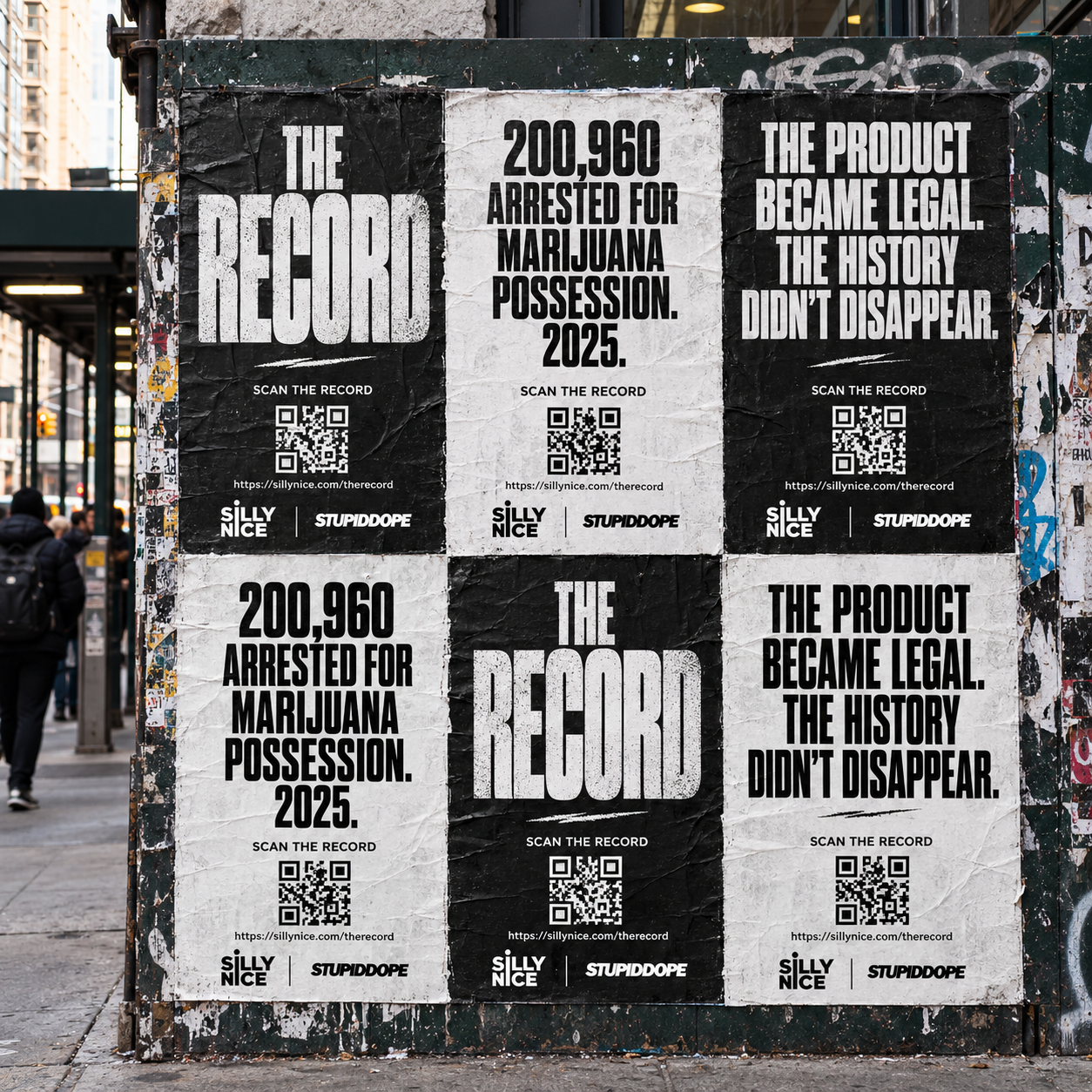
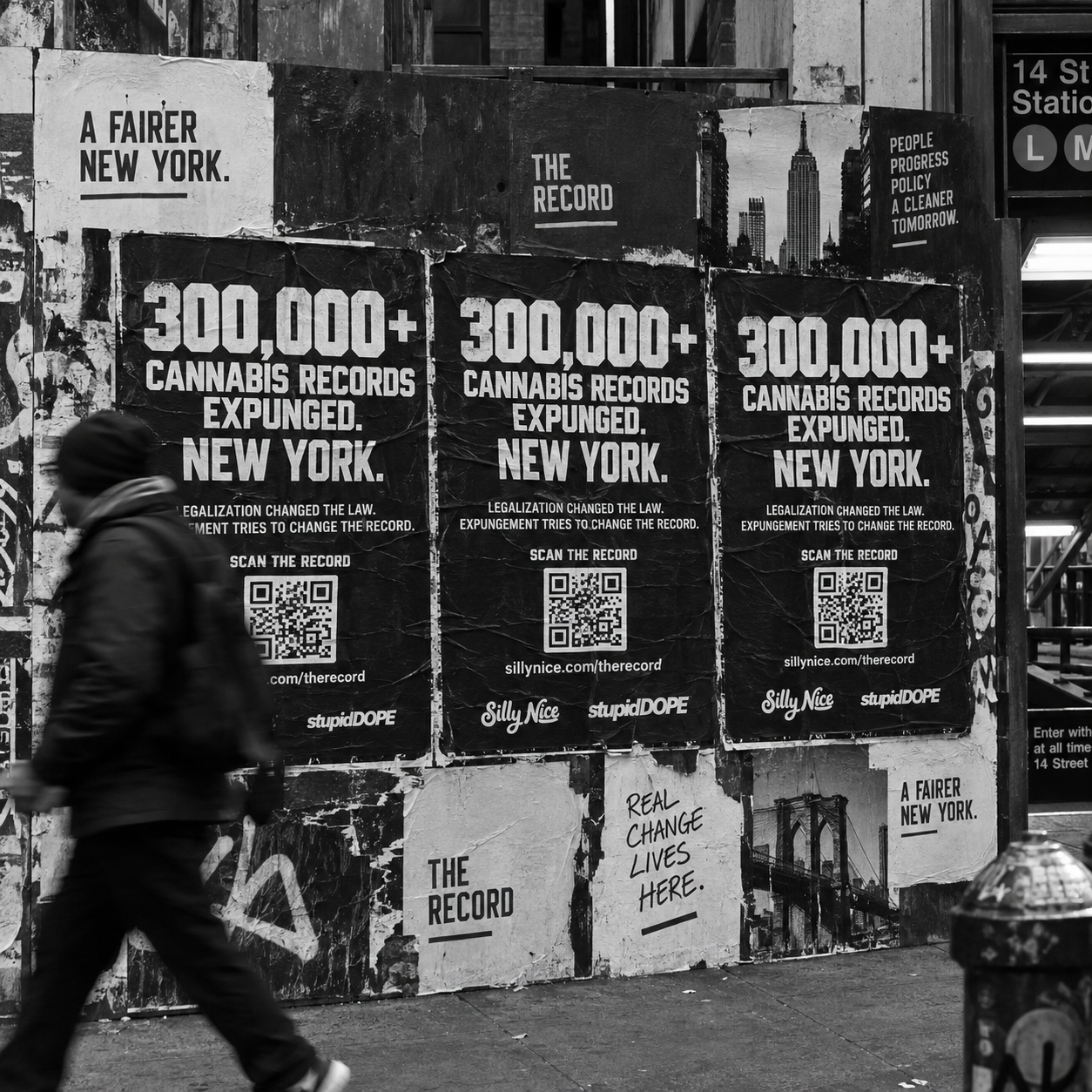
In an era where programmatic digital display buys can be executed across billions of impressions with a few mouse clicks, the streetscape remains one of media's final visceral frontiers. For public interest editorial initiatives and mission-driven media brands, reclaiming tactile public surfaces is not just an aesthetic decision; it is a calculated public intervention. When Silly Nice, the New York craft cannabis brand, joined forces with independent culture publication stupidDOPE to launch THE RECORD—an educational project analyzing cannabis arrest records, sentencing disparities, and expungement data through strictly sourced institutional records—the choice of medium was deliberate: high-contrast, black-and-white wheatpaste posters deployed across New York City's five boroughs.
Yet executing an physical out-of-home (OOH) campaign at significant scale—specifically deploying 4,000 posters across Manhattan, Brooklyn, Queens, and the Bronx—demands an unvarnished understanding of logistical finance. Street campaigns are often romanticized as spontaneous guerrilla art, but running thousands of high-visibility physical impressions across a densely regulated metropolis is an intricate industrial operation governed by press runs, paste formulation, route logistics, specialized labor, legal indemnification, and insurance overhead.
Production and Print Economics: The 4,000-Unit Run
The economic anatomy of any street campaign begins on the press floor. In outdoor wild posting and wheatpasting campaigns, the standard single-sheet unit measures 24×36 inches, printed on uncoated, light-weight 60 lb to 70 lb offset text stock or litho paper. Uncoated paper is essential: heavy gloss and polymer substrates reject the aqueous wheatpaste adhesive, leading to immediate blistering, curling, and environmental failure against brick, construction hoarding, or scaffolding surfaces.
Printing at the 4,000-unit threshold bridges short-run digital and high-volume offset lithography. At smaller runs of 100 to 300 units, print vendors rely on digital wide-format roll-to-roll printers, which run roughly $2.50 to $4.00 per 24×36 print. However, scaling to 4,000 units makes continuous sheet-fed or web offset lithography viable. At 4,000 impressions, large commercial print operations like Gorilla Printing can drive unit print costs down into the range of $0.85 to $1.35 per sheet for single-color black ink on lightweight stock, yielding an aggregate paper and printing expense of approximately $3,400 to $5,400.
Design pre-press and layout prep represent a modest, fixed cost within the larger budget. While initial creative strategy and conceptualization may cost thousands, technical production preparation—optimizing high-contrast monochrome vector type, embedding machine-readable high-density QR tracking codes, and ensuring compliance with edge bleeds—generally runs between $650 and $1,500 according to industry creative prep standards published by street marketing agencies.
Installation Labor and Crew Logistics Across the Five Boroughs
While paper and ink are predictable commodities, installation labor in New York City represents the single largest variable and capital expenditure. New York sits at the top of national labor rates for street execution due to traffic congestion, municipal enforcement, and high physical density. Industry benchmarks from street advertising providers indicate that professional wild posting installation in NYC ranges between $25 and $45 per location panel, depending heavily on surface accessibility and geographic distribution.
Installing 4,000 street-level posters cannot be completed by a rogue crew in a single evening. The standard execution strategy splits the run across multi-panel clusters—often grouping 4, 8, 12, or 24 posters per construction barricade or designated corridor to establish visual saturation and block-dominating presence. A 4,000-sheet campaign typically yields between 350 and 600 distinct deployment locations across targeted urban transit nodes.
Two-person tactical crews operating with utility vans, custom adhesive vats, telescoping paste brooms, and squeegees typically average 40 to 70 individual 24×36 applications per night shift over a 4- to 6-hour working window (typically 1:00 AM to 6:00 AM). Fully installing 4,000 posters requires roughly 60 to 90 collective crew shifts. Blended across crew wages, overnight hazard premiums, fleet van rentals, fuel, bulk methylcellulose and wheat starch materials, installation labor for a run of this scale realistically tallies between $22,000 and $38,000.
Permitting, Real Estate Rights, and the Hoarding Network
The operational divide in wild posting lies between unsanctioned guerrilla flyposting and permitted, secured construction hoarding. Under Section 10-119 and Section 10-121 of the New York City Administrative Code, posting handbills on public property—such as city lampposts, utility poles, litter baskets, and traffic signals—is an unpermitted violation subject to civil fines and sanitation summonses issued by the NYC Department of Sanitation (DSNY). For public editorial initiatives like THE RECORD, which prioritize institutional credibility and factual transparency, navigating the legal real estate layer is vital.
Commercial wild posting networks bypass municipal fines by leasing lawful posting rights directly from general contractors, real estate developers, and demolition firms managing temporary plywood sidewalk sheds and perimeter hoarding. Industry location sourcing fees for permitted construction barricades typically fluctuate between $5 and $25 per poster position per cycle, or flat monthly access fees ranging from $500 to $2,500 per site corridor.
Securing a lawful 4,000-sheet footprint spanning Lower Manhattan, Midtown, Williamsburg, Long Island City, and the South Bronx requires an allocated location lease and clearance budget ranging from $8,000 to $18,000. Operating through secured barricade networks also affords a critical strategic operational advantage: poster longevity. While unsanctioned street snipes are regularly scraped or painted over within 48 to 72 hours by municipal maintenance crews or rival street teams, legally leased site runs remain protected for standard 2-week to 4-week flight durations.
Insurance, Compliance, and Photographic Documentation
Professional agency campaigns require commercial risk management. Any enterprise operating on municipal sidewalks and construction perimeters carries Commercial General Liability (CGL) policies, typically carrying $1,000,000 per-occurrence and $2,000,000 aggregate coverage limits, often listing property developers as additional insureds. Allocated premium overhead and campaign-specific liability riders add $1,500 to $3,000 to campaign overhead.
Equally critical is the verification workflow. Unlike digital platforms where impressions are logged by automated ad servers, street-level media requires audit verification. Agencies utilize GPS-stamped, time-coded photography of every individual installation point. Compiling and indexing an interactive map of 4,000 deployed units—a requirement for institutional initiatives reporting to sponsors and public audiences—demands dedicated field auditors and reporting software, representing roughly $1,500 to $2,500 in logistics expense.
Consolidated Campaign P&L: The 4,000-Poster Matrix
When totaling each tier of execution across New York City's complex physical environment, the all-in investment for a 4,000-poster campaign breaks down into distinct budget components: print production ($3,400 – $5,400); prepress and file optimization ($650 – $1,200); installation crew labor and fleet logistics ($22,000 – $38,000); location agreements and hoarding clearance ($8,000 – $18,000); and insurance, compliance, and GPS photo documentation ($3,000 – $5,500).
The comprehensive gross capital outlay for deploying 4,000 street-level posters across New York City ranges from $37,050 on the conservative low end to $68,100 for high-density, fully permitted prime-corridor coverage, establishing a blended fully-loaded cost of approximately $9.25 to $17.00 per installed sheet.
OOH Impressions vs. Digital Spend: The CPM Disparity
To evaluate whether an expenditure of $40,000 to $60,000 represents efficient capital allocation, media buyers turn to Cost Per Thousand impressions (CPM). According to Clear Channel Outdoor and outdoor media measurement frameworks, OOH consistently delivers among the lowest effective CPMs across modern media channels.
In a densely populated pedestrian environment like New York City, pedestrian traffic data demonstrates that a focused 100-poster run in high-footfall corridors generates between 450,000 and 900,000 physical impressions over a 2-week deployment. Scaling that model to 4,000 posters strategically dispersed across key subway transfer hubs, university districts, and cultural corridors yields an estimated 18,000,000 to 36,000,000 gross visual impressions over a standard campaign cycle.
At a median production and deployment cost of $50,000, a 4,000-poster campaign delivering 25 million impressions achieves an effective CPM of roughly $1.50 to $2.75. By comparison, traditional static bus shelter panels in Manhattan routinely price out at $3,000 to $8,000 per panel for a 4-week window, achieving CPMs between $6.00 and $12.00, while highway billboards in the metropolitan area range from $5.00 to upwards of $30.00.
The Real Value: Unblockable Public Engagement
Comparing OOH economics strictly to programmatic digital spend reveals an even starker contrast. Programmatic web display and banner networks boast low baseline CPMs ($2.00 to $10.00), but digital formats suffer from severe digital banner blindness, ad-blocking software adoption exceeding 30%, and endemic click fraud. Paid social media channels such as Meta or LinkedIn command significantly higher CPMs—consistently pricing between $9.00 and $25.00+ for targeted urban demographics.
More critically, digital channels impose severe structural barriers on regulated categories. Mainstream digital ad networks enforce sweeping prohibitions on content touching cannabis, regardless of whether the spend is commercial or strictly public interest education. For an initiative like THE RECORD—which exists to surface verified government statistics on criminalization and social equity—social platform algorithms regularly flag, suppress, or outright reject public data campaigns addressing controlled substances and criminal justice reform.
The street offers no programmatic algorithm, no automated content moderation gatekeepers, and no ad-block toggles. A monolithic wall of 24 black-and-white posters placed at the corner of Bedford and North 7th in Williamsburg or Lafayette and Houston in SoHo stops pedestrians in their tracks. By embedding verifiable QR codes that bridge street foot traffic directly into long-form reporting and institutional datasets, a 4,000-poster run transforms the urban environment into an open-source civic classroom—proving that when executed with financial precision, the oldest format in advertising remains its most resilient.
Topics